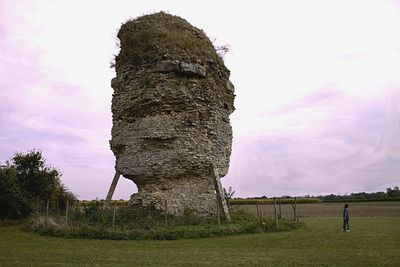
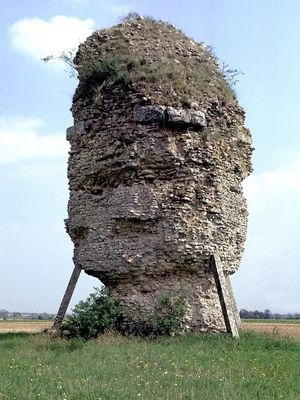
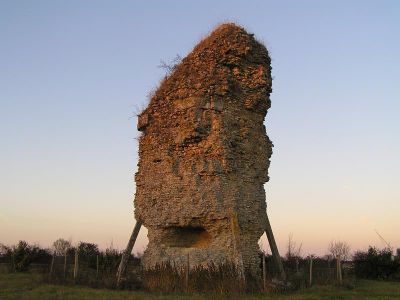
Fanal d'Ébéon, Roman monument in Authon-Ébéon, France.
The Fanal d'Ébéon is a solid Gallo-Roman stone pile at Authon-Ébéon, beside the D 129 road. It measures about 6 m square, oriented to the cardinal points, and rises 16 m; its facing stones were removed, leaving the rubble core exposed. A band of protruding stones forms a ledge partway up, and wooden props have braced it since the late 1930s.
Built in the Gallo-Roman period beside the Roman road from Poitiers to Saintes, the pile was probably the tomb of a wealthy local owner. Its large-block facing was later removed almost entirely, exposing the rubble core. It was listed as a monument historique in 1840, and wooden props have supported it since the late 1930s.
The name "fanal d'Ébéon" comes from the Latin fanum, meaning temple, though the tower was most likely the tomb of a wealthy local landowner. Ideas that it guided travellers on the Roman road or served as a landmark for sailors on the ocean have both been set aside. Since the late 1930s wooden props have held the masonry up.
The tower sits near the village center and can be reached by country paths, which are easiest to navigate during the warmer months. Visitors should wear sturdy footwear since the path to this site crosses uneven ground.
The name "fanal d'Ébéon" derives from the Latin fanum, meaning temple, yet the sources reject both the beacon-for-travellers and the landmark-for-sailors theories. The pile is more likely the tomb of a wealthy local landowner. Its dressed-stone facing was stripped away at an unknown date, leaving only the rubble core visible.
The community of curious travelers
AroundUs brings together thousands of curated places, local tips, and hidden gems, enriched daily by 93,685 contributors worldwide.