Site des trois bornes, Tripoint marker between Mont-l'Étroit, Clérey-la-Côte and Sauvigny departments, France.
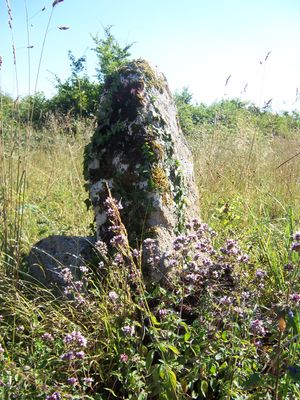
The site des trois bornes consists of three boundary stones on the wooded hilltop of Clérey-la-Côte, in the Côtes de Meuse at over 400 metres. The photographed stone is a tall grey marker, its lower block resting beside a flat slab, its upper part narrowing to a rounded top, coated with moss, lichen and ivy, with purple flowers growing around its base.
Before the Revolution, Sauvigny and Mont-l'Étroit belonged to the bishopric of Toul, while Clérey-la-Côte was part of the Duchy of Lorraine. On 22 December 1789 the Constituent Assembly decided to create the departments of Meurthe, Meuse, Vosges and Moselle, effective 4 March 1790. After the German annexation of 10 May 1871, the remaining parts of Meurthe formed Meurthe-et-Moselle, fixing the line where the three stones now stand.
Each of the three stones stands for one department: Meurthe-et-Moselle, Meuse and Vosges. Before the Revolution the surrounding parishes were divided between the bishopric of Toul, for Sauvigny and Mont-l'Étroit, and the Duchy of Lorraine, for Clérey-la-Côte. The stones are still visited by walkers following the ridge paths of the Côtes de Meuse.
The three stones stand in a grassy clearing on the wooded hilltop of Clérey-la-Côte, above 400 m, reached on foot via forest paths from the surrounding villages. The ground is uneven and partly overgrown with ivy and flowering plants around the bases, so sturdy footwear helps. The forest still shows fallen and broken trees from the 1999 storm.
This spot marks where exactly three departments meet, making it a relatively rare occurrence across Europe. Such triple boundaries required precise historical surveys and agreements between neighboring administrative regions.
The community of curious travelers
AroundUs brings together thousands of curated places, local tips, and hidden gems, enriched daily by 93,331 contributors worldwide.