Square René-Le Gall, Urban park in 13th arrondissement, Paris, France
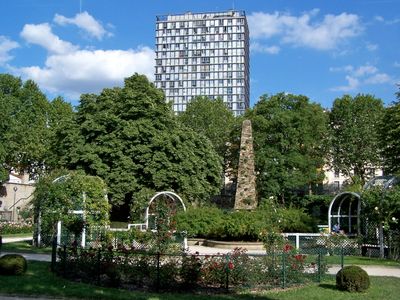
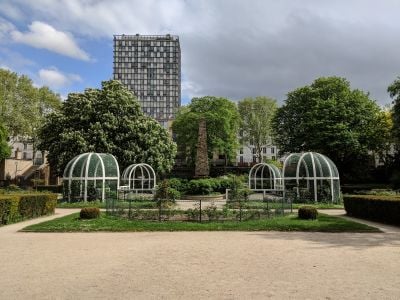
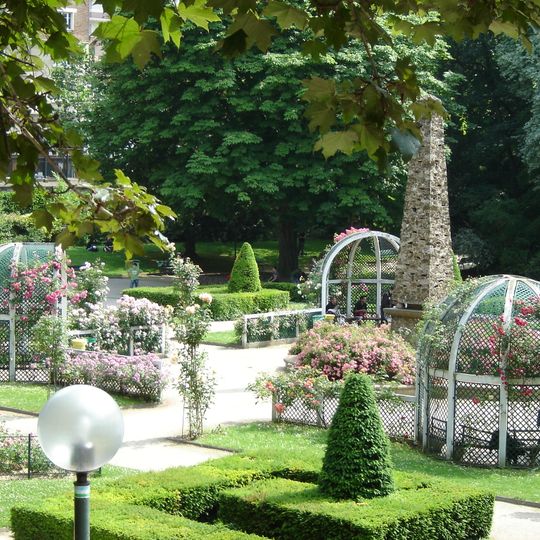
Square René-Le Gall is a 32,213 m² park in the 13th arrondissement of Paris, laid out on a slope with a high and a low section. Curved gravel paths with low stone edging lead past a slender grey stone obelisk rising from a grassy bed, white metal rose arches draped with red roses, and beds of red blooms behind low green wire fencing. A tall tapering column of rough stacked stone stands beside a large white metal cage-like arbor enclosing roses, and a white spherical lamp on a thin dark post marks a paved walkway bordered by low clipped hedges.
This park was created between 1936 and 1938 on a former industrial site where the Île aux Singes once stood. The area had previously been home to tannery workers who lived near the Bièvre River.
The square is named after René Le Gall, a Communist municipal councillor of the 13th arrondissement arrested by French police in November 1939 and held under the Occupation. On 7 March 1942 Nazi authorities had him shot dead at Clairvaux as a hostage, in retaliation for the Dijon attacks of 28 December 1941 and 10 January 1942. The name was given shortly after the Liberation.
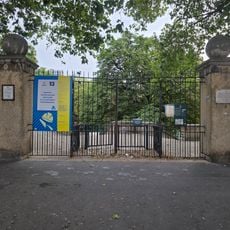
Multiple entrances lead into the space from surrounding streets, with the main one near Corvisart metro station at Place de la Bergère-d'Ivry. The area is best explored on foot and features different elevation levels throughout.
An artificial stream created in 1993 traces the former route of the Bièvre River through this location. The river itself flowed here until 1912, and this modern waterway makes its historic path visible again to visitors.
The community of curious travelers
AroundUs brings together thousands of curated places, local tips, and hidden gems, enriched daily by 94,097 contributors worldwide.