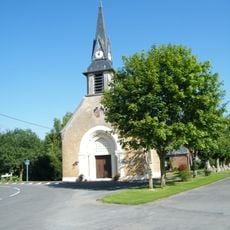
Sanctuaire de Ribemont-sur-Ancre, Celtic and Gallo-Roman sanctuary in Ribemont-sur-Ancre, France.
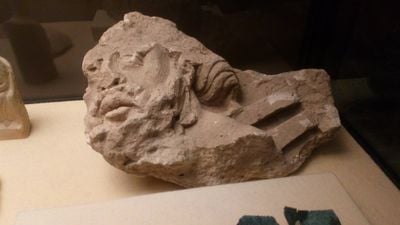
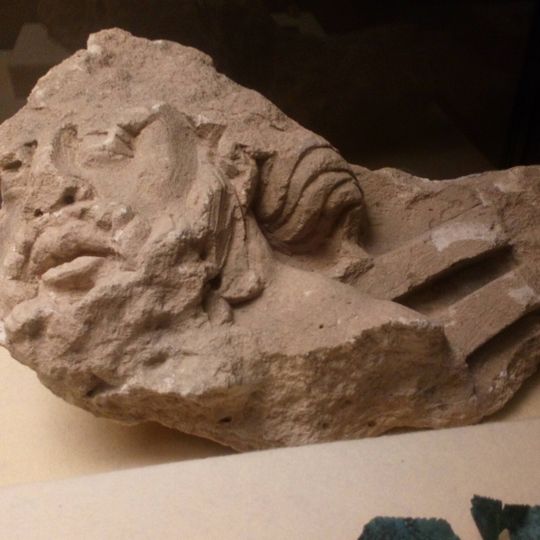
The sanctuaire de Ribemont-sur-Ancre covers about 80 hectares on three terraces on the right bank of the Ancre, running from the plateau down toward the village. Excavations revealed a Gallo-Roman town with baths, an amphitheatre, a 3,000-seat theatre and a temple to Mercury on the highest ground, overlying an earlier Celtic enclosure. Carved fragments from the temple include a light brown stone face with a hand against the mouth and hair curving backward.
Roger Agache identified the site by aerial survey in 1962, and a first publication followed in 1964; it was then taken for a large Gallo-Roman villa at a spot called Le Ch'Bœuf d'Or. Digging from 1966, led by Alain Ferdière under Ernest Will, and from 1970 by Jean-Louis Cadoux, uncovered a temple of the late 1st century BC. In 1982 Cadoux's Amiens team found the Celtic ditch, and 1987 brought many human bones.
The name recalls the Belgae, who founded the sanctuary after defeating the Armoricans around 270 BC. The site's layout follows the rising sun at the winter solstice. Visitors can see the remains of a cubic monument built from the long bones of 700 individuals aged 15 to 20, with no skulls found anywhere on the site.
The site is managed by a conservation and research center that preserves and studies findings on location. The most important artifacts are displayed at the Museum of Picardy in Amiens if you want to see a broader collection of objects from this place.
The grounds contain remnants of a theater that could hold thousands of spectators, revealing how important public gatherings were to the community. Beneath the surface lie communal burial pits holding skeletal remains of hundreds of ancient individuals, pointing to violent events that shaped the region's past.
The community of curious travelers
AroundUs brings together thousands of curated places, local tips, and hidden gems, enriched daily by 93,625 contributors worldwide.