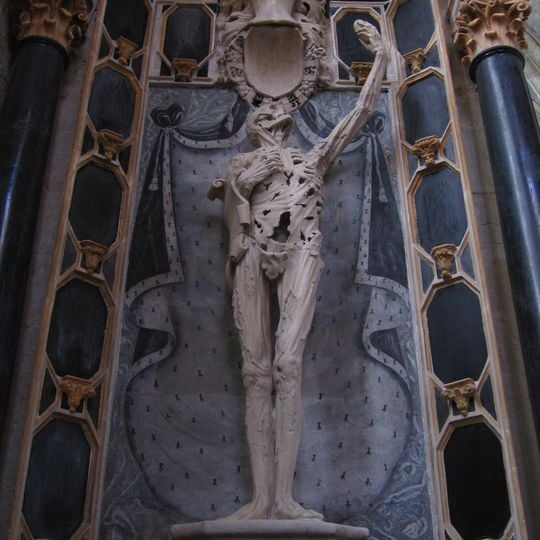
Cadaver Tomb of René of Chalon, Cadaver tomb in Saint-Étienne Church, Bar-le-Duc, France
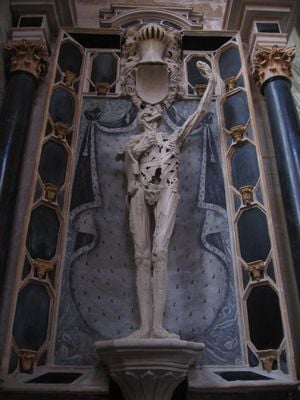
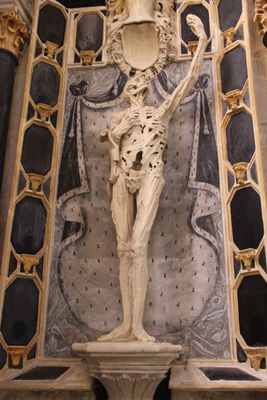
The Cadaver Tomb of René of Chalon is a life-sized limestone statue, 177 cm tall, of a putrefied, skinless corpse standing upright above the altarpiece in Saint-Étienne Church. Its left arm is raised outward, its right hand rests on the chest, and the torso is split open with jagged edges. The figure stands on a stylobate supported by two black marble columns with Corinthian capitals, beneath a dark niche with gold detailing.
René of Chalon, Prince of Orange, died on 15 July 1544, aged 25, from a wound received the previous day at the siege of Saint-Dizier. His widow, Anna of Lorraine, commissioned the tomb from Ligier Richier; it was begun after 1544 and finished before 1557. It was classified as a Monument historique on 18 June 1898, moved to the Panthéon in Paris during the First World War, and returned to Bar-le-Duc in 1920.
The figure's raised left hand once held a heart-shaped reliquary, probably of gilded silver, said to contain René's embalmed heart; it vanished during the Revolution. The pose is often read through Job 19:26 and the three virtues: eyes to heaven (faith), right hand on the chest (hope), heart raised to God (love).
The tomb stands in the church of Saint-Étienne in Bar-le-Duc, above the carved altarpiece. It was moved to the Panthéon in Paris during the First World War and returned in 1920. The statue and altarpiece were restored between 1998 and 2003.
In 1793 a French soldier stole the statue's outstretched hand; the replacement was shown holding a clepsydra or hourglass, turning the figure from a portrait of René into a personification of death. The raised hand now holds a plaster heart, replacing the lost gold or gilded-silver vermeil vessel.
The community of curious travelers
AroundUs brings together thousands of curated places, local tips, and hidden gems, enriched daily by 92,893 contributors worldwide.