Vestiges archéologiques du Clos de la Lombarde, Archaeological site in northern Narbonne, France.
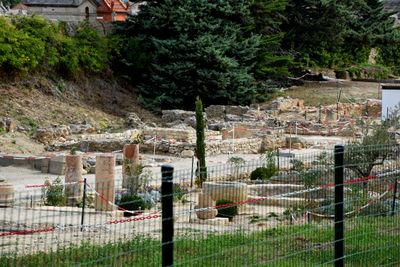
The Vestiges archéologiques du Clos de la Lombarde occupy a flat dirt and gravel area where low walls of rough pale beige and grey stone blocks outline rectangular foundations. Several cylindrical column bases and a squared pillar stand upright, and a thin dark green cypress-like tree grows among the stones. The excavated island measures 90 m by 23.5 m and contains two large domus, the Maison à Portiques and the Maison au Grand Triclinium, plus part of a bath complex.
In October 1910 the landowner Donnadieu had a well dug and two sarcophagi came to light. In 1973, before a tax office could be built on the vineyard, preventive excavations revealed wall paintings and mosaics of the 1st and 2nd centuries plus an early Christian basilica. The Finance Ministry handed the plot to the Culture Ministry, digs began in 1974 under the Groupe de Recherches Archéologiques du Narbonnais, and the site was classified as a monument historique in 2007.
The site's name comes from the Clos de la Lombarde, the vineyard plot bought by the Ministry of Finance in the early 1970s. The finds, notably frescoes and mosaics, were kept and displayed at the archaeological museum of Narbonne. In the baths, an altar dedicated to the goddess Isis was found, and a small votive altar bearing the name Marcus Clodius Aestivo came from the House of the Great Triclinium.
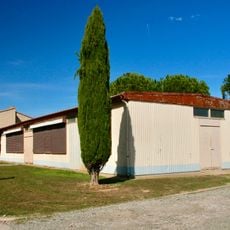
The site lies at 28 rue Chanzy, beside the Cité cemetery and near the SNCF station. Volunteers of the association Les Amis du Clos de la Lombarde welcome visitors two days a week in July and August, and open the grounds during the Journées de l'archéologie in June and the Journées du patrimoine in September. Most of the area is open to the sky, with low walls and column stumps among gravel and dirt.
The early Christian basilica, built at the end of the 4th century, measures 27.5 by 13.7 metres and was abandoned in the first half of the 5th century. It stood outside the city walls of the time, on part of the Maison à Portiques, and its plan recalls churches of northern Syria.
The community of curious travelers
AroundUs brings together thousands of curated places, local tips, and hidden gems, enriched daily by 94,658 contributors worldwide.