Chaumont Viaduct, Railway viaduct in Chaumont, France
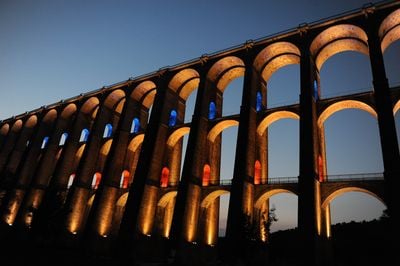
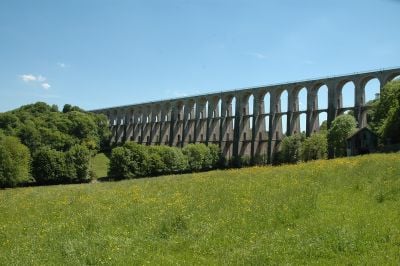
The Chaumont Viaduct is a 600-metre railway viaduct of natural stone masonry, 50 metres high and 8.10 metres wide, crossing the Suize valley west of Chaumont. It has three tiers of arches: 50 round arches of 10 metres span on top, 46 of 9.50 metres in the middle and 23 of 9.25 metres below, all with a 5-metre radius so the same centring could be reused. A public footpath runs through the lowest tier.
Built for the Compagnie des chemins de fer de l'Est to plans by engineer Eugène Decomble and his superior Zeiller, the viaduct went up in fifteen months, from 21 August 1855 to 25 November 1856, with up to 2,500 workers, 300 horses, a steam locomotive and five stationary steam engines on site. On 31 August 1944 German troops blew up piers; the gap was closed by November 1945 with reinforced concrete faced in natural stone. Major maintenance followed in 2016 and 2018.
The viaduct has appeared on screen: it and Chaumont station served as settings for the films Le Pacha, Le Cerveau and Un étrange voyage, and the TV film De Gaulle et le Chancelier. A French postage stamp depicting the viaduct was issued on 18 January 1960.
The viaduct crosses the Suize valley on the western edge of Chaumont, over the D65 and three small local roads, at kilometre point 260.7 of the Paris-Est–Mulhouse line, less than a kilometre from Chaumont station. A public footpath runs through the lower tier of arches; the walkways on the second tier and on the deck are reserved for railway staff.
Five arches are framed by thicker piers topped with four guttae instead of the usual two; these act as abutments so that a single collapsed arch would only affect its group of five. The piers widen from 8.10 m at the deck to 15.88 m at the base.
The community of curious travelers
AroundUs brings together thousands of curated places, local tips, and hidden gems, enriched daily by 93,757 contributors worldwide.