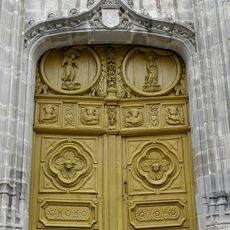
Église Notre-Dame de Vitré, Gothic church in Vitré, France.
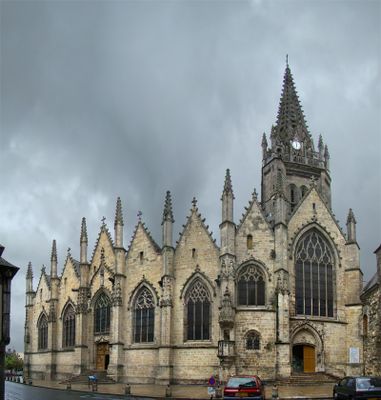
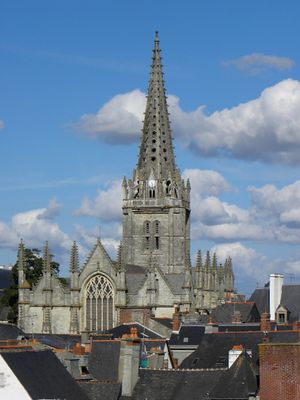
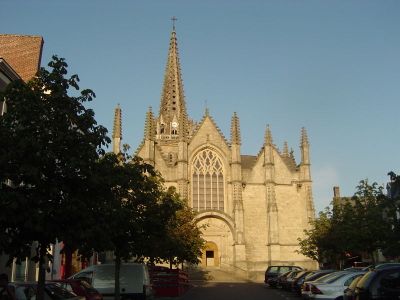
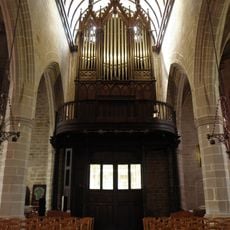
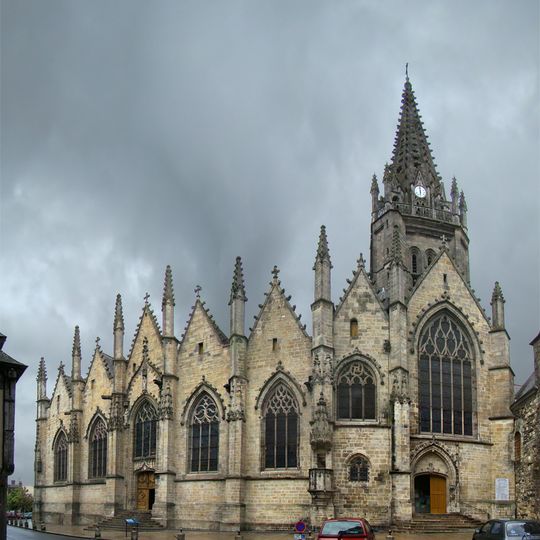
Église Notre-Dame de Vitré is a Gothic church in Vitré, France, with high vaulted ceilings, pointed arches, and stone walls that show how medieval French builders worked. Inside, the Gothic style creates a sense of height and openness through its stone structures and architectural forms.
A collegiate church existed here by 1070–1075, and around 1060 Robert I of Vitré was long credited with founding it, a claim shaped by Arthur de La Borderie's Breton nationalism. In 1116 Bishop Marbode of Rennes gave it to the Benedictine abbey of Saint-Melaine, and the canons left in 1132. The present building was rebuilt from the 15th century: the transept crossing in 1440–1442, the north aisle in 1467, the south transept and chapels in 1480–1500, and the west facade around 1580.
The parish served Vitré's wealthy overseas merchants, and the Confrérie des Marchands d'Outre-Mer was founded in 1473 in the fifth chapel on the north side. Look for the merchants' marks carved on the buttress west of the exterior pulpit, one dated 1499. The sandstone pulpit built against the south facade around 1490–1500, with a three-faced head symbolising the Trinity, was used until the early 20th century.
You can enter through the main doorway at Place Notre-Dame, and it is best to visit when services are not taking place. Hours generally run from morning through evening, but it is smart to check in advance if the entrance is available at your intended time.
The south side has seven gables, built in two campaigns between 1480–1500 and 1530–1540. An exterior stone pulpit carved around 1490–1500 clings to a buttress there, its corbel showing a three-faced head as a symbol of the Trinity; it was used until the early 20th century.
The community of curious travelers
AroundUs brings together thousands of curated places, local tips, and hidden gems, enriched daily by 93,146 contributors worldwide.