Église Notre-Dame de Surgères, Romanesque church in Surgères, France
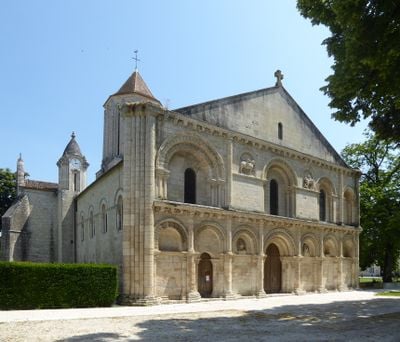
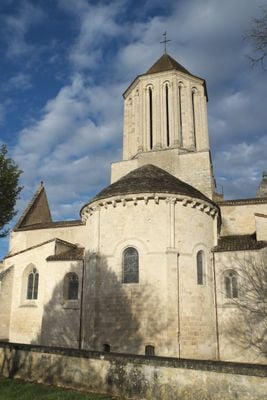
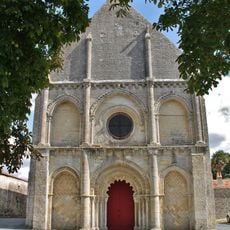
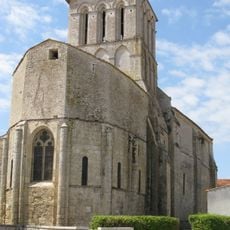
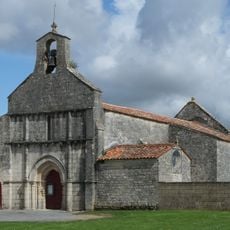
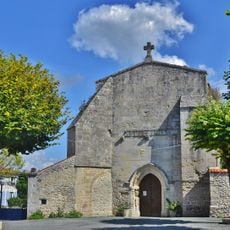
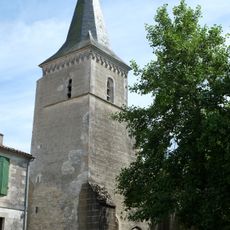
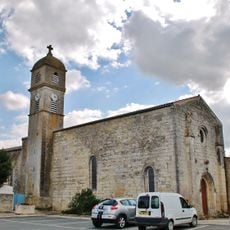
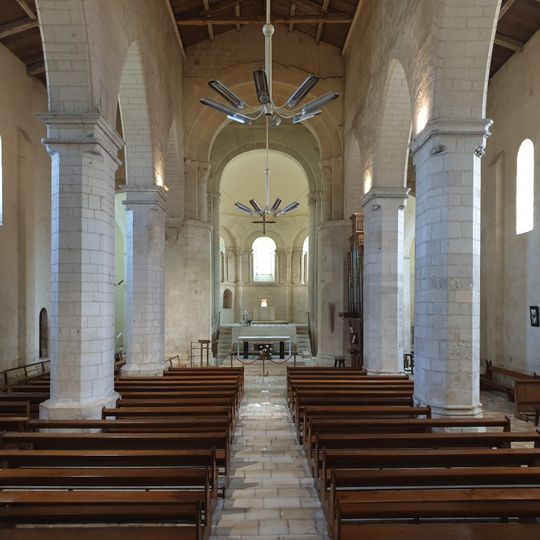
Église Notre-Dame de Surgères is a Romanesque church with a west facade 27 metres long, wider than it is tall, framed by thick column bundles and topped by a plain triangular gable. Two cornices divide it horizontally; the lower level has seven blind arches around the central portal, and the upper level has four arches, three pierced by windows, with two mounted figures in small niches. The octagonal bell tower rises over the crossing on a square base.
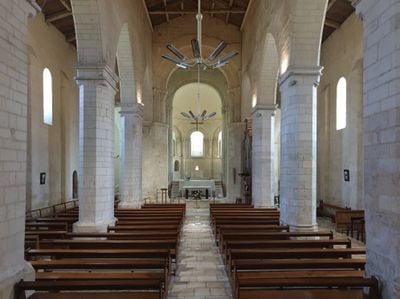
Founded in the first half of the 11th century, the church belonged to the counts of Poitou, who gave it to the Benedictine abbey of La Trinité in Vendôme at the end of the 11th century. The west facade was built in the 12th century. After damage in the Hundred Years' War, the nave and transept arms were rebuilt in the 15th century, and a crypt was added under the choir in the 16th century. Juste Lisch directed a restoration in 1880, and the bell tower was rebuilt higher after a lightning strike in 1899.
The west facade carries a band of small kneeling figures above the lower cornice, and its archivolts and capitals show elephants, lions, griffins and winged dragons. On the metopes appear an acrobat, a musician, a bear handler, a musical monkey, a mermaid and a siren. Two mounted figures face each other in the upper field; the right one is read as Emperor Constantine, with a figure under his horse's hooves symbolising paganism.
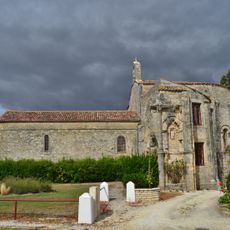
The church stands inside the old walled castle enclosure, facing the former château site, so approach on foot through the village centre. The west facade is best read in raking morning light, when the carvings on the archivolts and the band of kneeling figures stand out. Allow time to walk round to the chevet, whose exterior is far plainer than the facade.
The crypt under the apse is covered by four low, flattened rib arches resting on a single central pillar, and its vaults carry 16th-century paintings of angels blowing trumpets for the Last Judgment, restored in 2003. The burial vault below, violated during the Revolution, had held the tombs of the lords of Surgères.
The community of curious travelers
AroundUs brings together thousands of curated places, local tips, and hidden gems, enriched daily by 94,658 contributors worldwide.