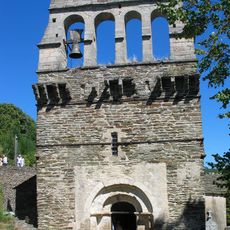
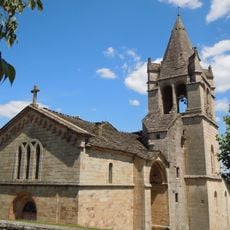
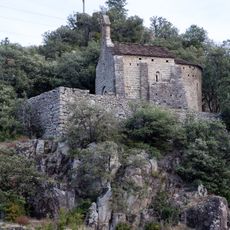
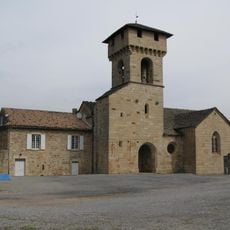
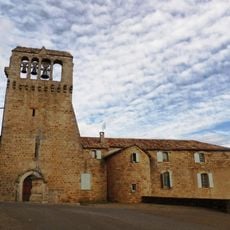
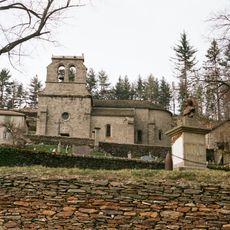
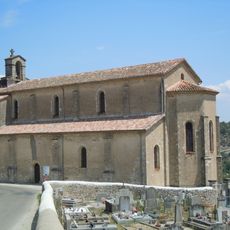
Église Notre-Dame de Thines, Romanesque church in Malarce-sur-la-Thines, France.
Notre-Dame de Thines is a Romanesque church with polychrome masonry, built of light grey rectangular stone blocks alternating with reddish-brown and grey stones. Its curved exterior wall carries a band of small decorative arches and a central arched window framed by a radiating pattern of alternating stones, with a smaller engaged column to the left. A monumental staircase leads up to a portal with four statue-columns and a carved lintel.
Benedictine monks built the church between 1170 and 1190, and it depended on the Abbey of Saint-Chaffre du Monastier. In 1587 Huguenots pillaged the village and took the elderly priest prisoner; the portal statues were defaced at that time. The 1862 list of historic monuments classified the church.
The church stands near the old pilgrimage roads linking Le Puy-en-Velay with Santiago de Compostela, and its Benedictine builders depended on Saint-Chaffre Abbey at Le Monastier. The portal's four statue-columns were defaced in 1587, when Huguenots pillaged the village and took the elderly priest prisoner after failing to seize the fort of Thines.
The church stands in the hamlet of Thines, in the commune of Malarce-sur-la-Thines, reached by road from Malarce; the monumental access staircase leads up to the portal with its four statue-columns. The building is a classified monument and the isolated village has few visitors, so the carved capitals and chevet can be examined at leisure.
The 14th-century polychrome wooden Virgin and Child, Notre-Dame de Thines, was classified as a historic object on 4 January 1944, but it was stolen from the church in 1973 and has not returned. The Romanesque church itself was listed as a monument in 1862.
The community of curious travelers
AroundUs brings together thousands of curated places, local tips, and hidden gems, enriched daily by 93,895 contributors worldwide.