Église Saint-Gervais de Rouen, Romanesque Revival church in Rouen, France
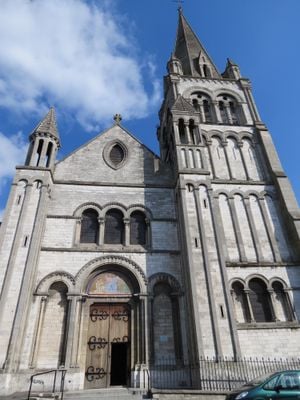
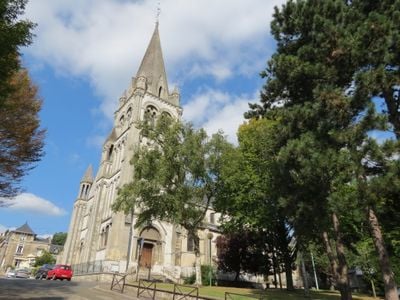
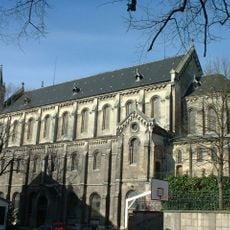
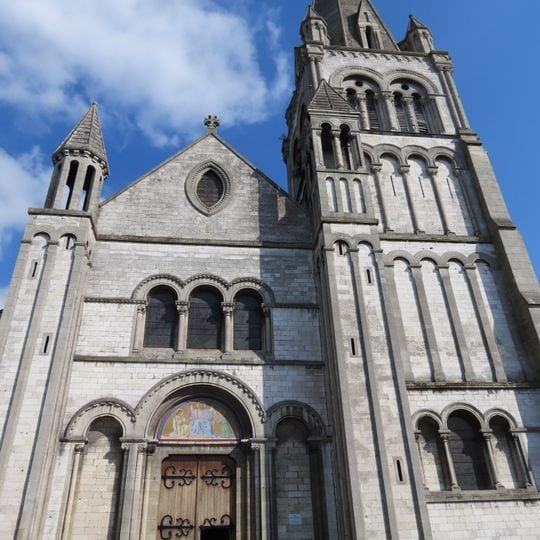
Église Saint-Gervais is a neo-Romanesque church built between 1868 and 1874 by the architect Martin Pierre, with ribbed vaults. Its grey stone facade has two unequal towers: a shorter one with a pointed roof and a taller flat-topped one with paired arched openings. A small quatrefoil window sits in the central gable above three arched windows and a large portal with wooden double doors and a semicircular mosaic.
A priory dependent on Fécamp Abbey stood here from the 11th century; William the Conqueror died there on 9 September 1087. The church was demolished in 1418 before the English siege, rebuilt in 1434, damaged in 1560-1562 and in 1591, then rebuilt in neo-Romanesque style by architect Martin Pierre between 1868 and 1874. The pre-1000 crypt was classified as a monument historique in 1840.
The choir fresco by Savinien Petit has a central panel with a cross, framed by six painted panels showing Saint Thomas Becket, Saint Mellon, Saints Gervasius and Protasius, Saint Victricius and Saint Andrew. Two sarcophagi from the ancient cemetery are displayed inside the church.
The church stands on Place Saint-Gervais at the corner of Rue Claude-Groulard, in Rouen's historic centre. The medieval crypt, classified as a monument historique since 1840, lies beneath the choir and is reached from inside the building. Two sarcophagi found in the ancient cemetery are displayed in the church.
The priory that preceded the church was made a ducal residence, and William the Conqueror died there on 9 September 1087. The present neo-Romanesque building dates from 1868-1874, but the pre-1000 crypt under the choir survived the demolition and is classified as a historical monument.
The community of curious travelers
AroundUs brings together thousands of curated places, local tips, and hidden gems, enriched daily by 93,011 contributors worldwide.