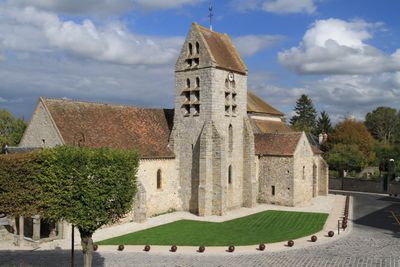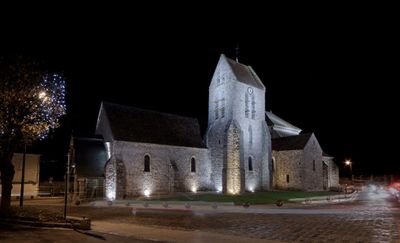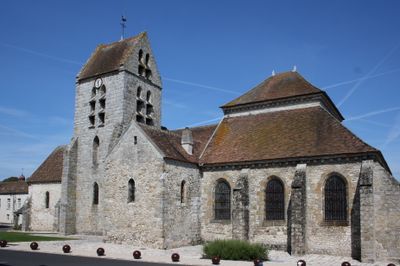
Saint Peter Church of Avon, church located in Seine-et-Marne, in France
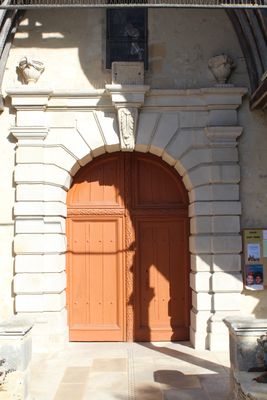
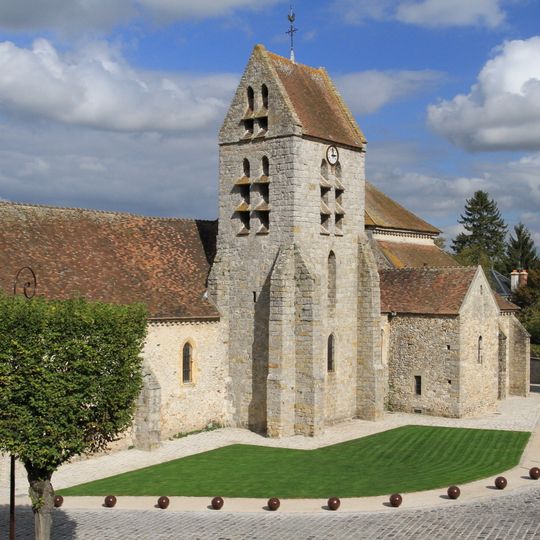
Saint-Pierre d'Avon is a limestone and sandstone church begun around 1100, with a 12th-century square bell tower topped by a brown tiled roof and a clock face. Its west portal, rebuilt in the 16th century, is round-arched with pilasters and a carved keystone; a 17th-century open porch with a curved roof stands before it. The interior has a three-aisled nave, a Flamboyant Gothic choir of 1555, and 19th-century stained glass.
Construction began around 1100 in limestone and sandstone, giving a Latin-cross plan with the present nave and transept; the square bell tower dates from the 12th century. In 1259 the parish was attached to the diocese of Sens, and the church became royal when French kings staying at the hunting lodge that grew into the Château de Fontainebleau came to hear mass. The apse was removed in 1555 for Jean de Monceau's Flamboyant Gothic choir, and the building was classified as a monument historique on 20 July 1908.
The church became a royal church because French kings staying at the hunting lodge of La Fontaine Belle Eau, later the Château de Fontainebleau, came to hear mass here. From 1549 until the Revolution its priests were chosen from the Trinitarian order, and the Trinitarians' general had the vault in front of the choir dug in 1690 for their burial. In the left aisle a recent window commemorates the twenty-three Avonnais who died in concentration camps, among them Father Jacques and former mayor Rémy Dumoncel.
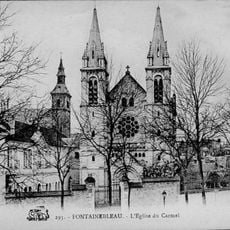
The church stands in Avon's historic centre beside the Carmelite convent, with the Fontainebleau forest and château a short walk away. A levelling mark on a bell-tower buttress, 60 cm above the ground, records an altitude of 73.608 m. The worn threshold stone at the entrance has been trodden for some 900 years.
In 1875 fifty-six worn floor slabs were lifted and fixed to the right aisle wall, among them that of mathematician Étienne Bézout. Near the entrance lies the slab of Jean de Monaldeschi, equerry of Queen Christina of Sweden, killed on her orders in 1657 in the Galerie des Cerfs of the palace.
The community of curious travelers
AroundUs brings together thousands of curated places, local tips, and hidden gems, enriched daily by 92,856 contributors worldwide.