Église Saint-Symphorien de Charmont-sous-Barbuise, Classified historical monument and church in Charmont-sous-Barbuise, France
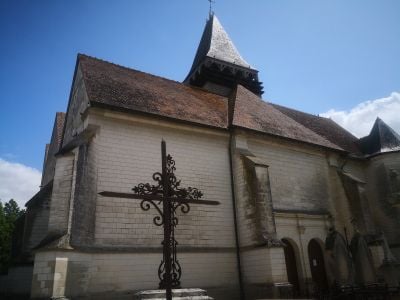
The église Saint-Symphorien de Charmont-sous-Barbuise is a church in the Aube village of Charmont-sous-Barbuise, built largely in the 16th century and classified as a historical monument in 1928. Its light grey stone walls carry pointed-arch windows with dark glass, and a square spire clad in dark shingles rises from the centre, topped by a cross and weather vane above an open timber belfry ring. A small round turret with a dark conical roof adjoins the right side, and a red metal gate with vertical bars stands in the low stone wall in front.
The church was a cure dependent on the Grand Doyenné de Troyes, with the bishop holding the right of collation. A tithe given in 1199 by Milon de Colaverdé was granted to the cure in 1697 by the chapter of Saint-Étienne de Troyes. The building, largely of the 16th century, was classified as a monument historique in 1928.
The church keeps a set of 16th-century furnishings: a limestone Virgin of Pity, a limestone Saint Barbara, a polychrome limestone high relief of the Saint Hubert hunt, a limestone baptismal font, and a polychrome Saint Nicholas. Two limestone Virgin and Child statues retain traces of 14th-century polychromy, one with two separate paint layers.
The church sits in the heart of the village and is easy to reach on foot. It is mainly open for special occasions, so it is worth checking with the local town hall before planning a visit.
Inside the church, a wooden gallery above the entrance is made up of nine panels, each bearing a coat of arms. This kind of heraldic display is rare in a village church of this size and suggests ties to local noble families.
The community of curious travelers
AroundUs brings together thousands of curated places, local tips, and hidden gems, enriched daily by 94,658 contributors worldwide.