Église Sainte-Quitterie d'Aire, Gothic church on the Mas hill in Aire-sur-l'Adour, France
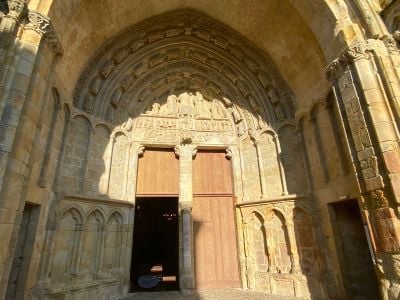
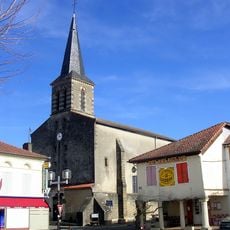
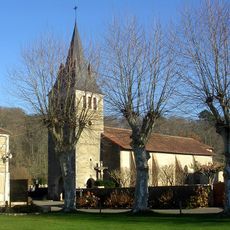
Église Sainte-Quitterie d'Aire stands on the Mas hill southwest of Aire-sur-l'Adour. Its Gothic nave and facade, rebuilt from the late 13th century, are built of light brown and reddish stone and brick, with a pointed-arch portal whose carved tympanum shows Christ in majesty between the kneeling Virgin and Saint John. The square bell tower, rebuilt in the 17th century, rises above the facade with rows of arched openings; the chevet, from the late 11th or early 12th century, continues into a crypt.
The church stands on the hill of Mas on the site of a Roman temple to Mars, later turned into a baptistery by the bishops of the Tarusates. Benedictine monks, perhaps from La Chaise-Dieu, received it from Bishop Pierre I of Aire in the 11th century and built an abbey beside it. The chevet dates from the late 11th or early 12th century; the church was rebuilt in Gothic style from the late 13th century, and Montgomery's troops devastated the buildings in 1569. Classified in 1840, it was the first listed monument in the Landes and was inscribed by UNESCO in 1998 on the Routes of Santiago de Compostela.
The church is also called Saint-Pierre-du-Mas, and its name recalls Quitterie, a young Visigoth princess martyred in the legend. A spring beside the crypt is said to be where she laid down her head; the white marble sarcophagus in the underground niche was long believed to hold her relics. The Benedictine monks who received the church in the 11th century built an abbey nearby to sustain the cult.
The church stands on the Mas hill southwest of Aire-sur-l'Adour. The crypt, reached through the south absidiole, holds the white marble sarcophagus and lies below the raised chevet, so allow for steps and low light. The square bell tower was rebuilt in the 17th century and rises above the facade.
The white marble sarcophagus in the crypt, 2.12 m long and carved from Saint-Béat marble, is thought to date from the 4th or 5th century and to have held Saint Quitterie's relics until the 16th century. It was listed as an object in 1903 and appears in the Palissy database. A spring flows nearby, where legend says the saint laid her head.
The community of curious travelers
AroundUs brings together thousands of curated places, local tips, and hidden gems, enriched daily by 93,000 contributors worldwide.