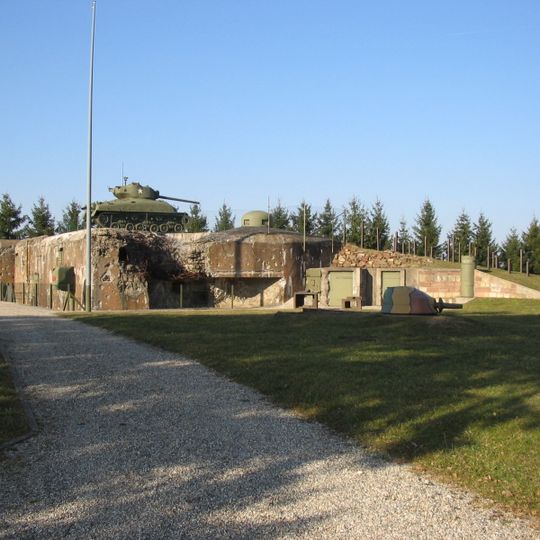
Casemate of Esch, Military museum of the Maginot Line in Hatten, France.
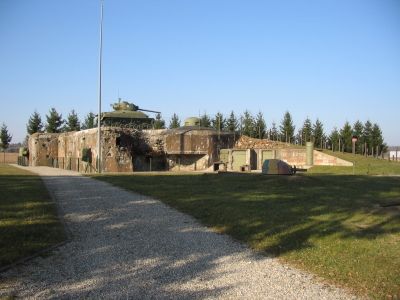
The Casemate d'Esch is a single-level double casemate of reinforced concrete, about 28 by 18 metres and 7.5 metres high, set into a small hill north of Hatten. Its front face holds two large embrasures for twin heavy machine guns and 47mm anti-tank guns, with smaller automatic rifle ports. On the roof sit two GFM cupolas and an American M4 Sherman tank placed as a memorial.
Built in 1931 by the Commission d'Organisation des Régions Fortifiées, the casemate was one of the first in a line extending east from Ouvrage Schoenenbourg, costing about 1.06 million francs. Its 21-man garrison of the 23rd Fortress Infantry Regiment surrendered on 1 July 1940 without seeing combat. In January 1945 the US 14th Armored Division dug in among the casemates during Operation Nordwind; the structure was heavily damaged and the area retaken by French First Army Tabors Marocains on 18 March 1945.
The name Esch comes from the Alsatian word for a farmer's harrow, a reference to the shape of the terrain. The casemate was garrisoned by 21 troops of the 5th company, 23rd Fortress Infantry Regiment, under Sub-lieutenant Barthet in 1940. An American M4 Sherman tank now stands on the roof as a memorial to the 1945 fighting.
The casemate is a single-level structure of about 28 by 18 metres, entered past a projecting caponier that once defended the doorway with automatic rifle fire. It sits on a small hill at the southeastern edge of Hatten, with an earth embankment studded with anti-tank rails facing north. Tours have run since 1986; the site is reached from the town and is associated with the Ouvrage Schoenenbourg museum.
The outer walls still bear bullet holes and scuff marks from projectiles fired during the 1945 fighting. These visible scars show the intense bombardment the structure endured.
The community of curious travelers
AroundUs brings together thousands of curated places, local tips, and hidden gems, enriched daily by 92,952 contributors worldwide.