Château de Hohenack, Medieval castle ruins in Labaroche, France.
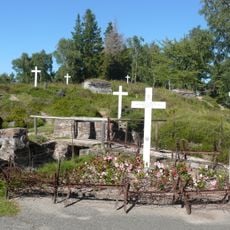
Château de Hohenack is a ruined hilltop castle on the 927 m summit of the Petit-Hohnack near Labaroche. Its 12th-century square keep survives as an 8 m stump, and the polygonal curtain wall was later flanked by two square bastions, a round battery tower and a gate tower with barbican. The masonry uses bossed ashlar blocks, and a curved section of wall with a small square opening stands in the grass.
A later chronicle mentions the castle as already existing in 1079, held by the Counts of Eguisheim, though this is considered doubtful. A family of Hohnack appears in the mid-12th century holding it as a fief of the Counts of Pfirt, who enfeoffed it to the Bishop of Strasbourg from 1251. After passing through the Ribeaupierre and Lupfen families, it returned to the Ribeaupierres in 1438. In 1635 a French garrison took and destroyed it, and from November 1655 Louis XIV ordered its final demolition.
The name Hohnack probably derives from "Hohen Acker", the high field. The four surviving towers carry local names: Hexenturm (witches' tower) to the west, Mühlenturm (mill tower) to the northwest, Kapellenturm (chapel tower) to the south, and the gate tower to the east. The site also yielded bombardes from the late 14th or early 15th century.
The climb is manageable but requires good hiking shoes and moderate fitness on a well-marked trail. The best visit is on clear days when views across the Vosges are rewarding and the path is easiest to navigate.
The castle's name likely derives from "Hohen Acker", the high field. Excavations on the site yielded bombardes, early firearms dating from the late 14th or early 15th century, evidence of the castle's modernisation for gunpowder warfare.
The community of curious travelers
AroundUs brings together thousands of curated places, local tips, and hidden gems, enriched daily by 94,534 contributors worldwide.