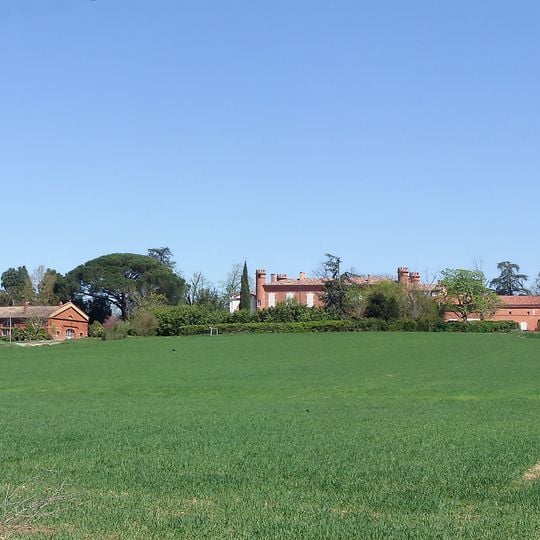
Château de Villefranche, Renaissance castle in Villeneuve-lès-Bouloc, France.
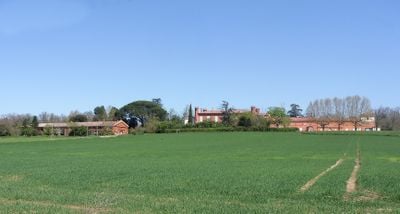
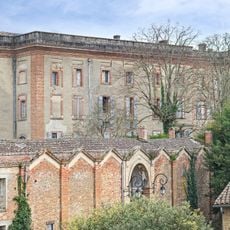
Château de Villefranche is a long, low castle of reddish brick in Villeneuve-lès-Bouloc, its central block under a steeply pitched tiled roof with small dormers. A lower left wing ends in a rounded tower capped by a shallow dome, while the right side continues to a taller, flat-topped tower. Rectangular windows, some with pale shutters, punctuate the facade, and a single slender cypress stands before the central block on a grassy field.
Built in the 16th century as the seat of the joint lord of Villeneuve-lès-Bouloc, the castle became a grand house at the end of that century. It was redeveloped in line with contemporary taste in the 18th and 19th centuries. The French Ministry of Culture listed it as a monument historique in 2005.
The castle was the seat of the joint lord of Villeneuve-lès-Bouloc, and its name recalls that seigneurial role. Inside, several rooms keep wallpaper hung in the 1810s, a rare surviving interior finish. The outbuildings, including 18th-century farm buildings and a sheep pen dated 1868, show the estate was also a working farm.
The Château de Villefranche is a privately owned residence in Villeneuve-lès-Bouloc, Haute-Garonne, listed as a monument historique since 2005, so it is not open to the public as a museum. Visitors see the brick facade, the domed tower and the flat-topped tower from the road and the surrounding grounds. Check locally before planning a stop.
The outbuildings hold a sheep pen dated 1868, a trace of the estate's farming past that visitors often miss while looking at the main house. The 18th-century farm buildings stand alongside it, and the whole property has been listed as a monument historique since 2005.
The community of curious travelers
AroundUs brings together thousands of curated places, local tips, and hidden gems, enriched daily by 93,130 contributors worldwide.