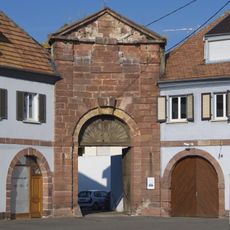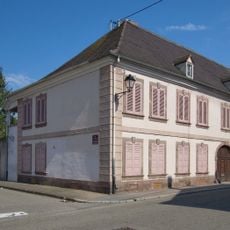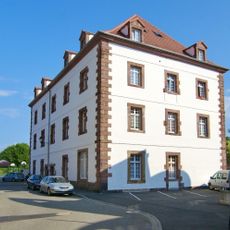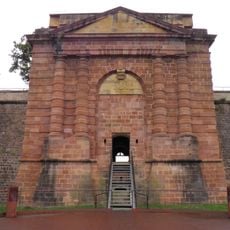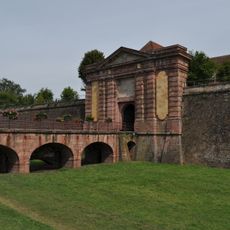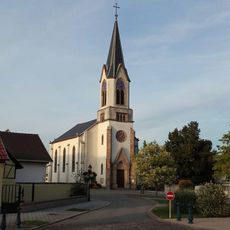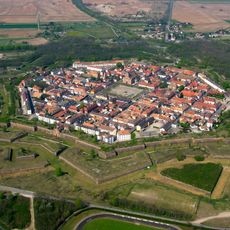
Ramparts of Neuf-Brisach, Military fortification in Neuf-Brisach, France.
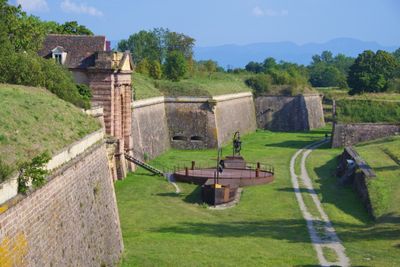
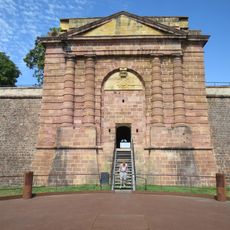
The Ramparts of Neuf-Brisach form a complex defensive system with eight corners, bastions, ditches, and gates that extends over several kilometers. The entire structure was built according to mathematically precise plans and shows how fortified towns were designed in the 17th century.
After the 1697 Treaty of Ryswick forced France to give up the fortress of Breisach on the German bank of the Rhine, Louis XIV ordered a new fortified town half a league from the river, designed by Vauban and Jacques Tarade. The first stone was laid on 18 October 1698 and the fortifications were finished in 1702; pink Vosges sandstone was brought by a canal dug for the purpose. In 1870 the garrison of 5,500 men and 108 guns held out for 33 days before capitulating, and from 1875 the works were rebuilt as a German bridgehead.
The fortifications show French defensive architecture through their rational geometric design, which combined military efficiency with building excellence. Visitors can see today how this structure shaped daily life in the town.
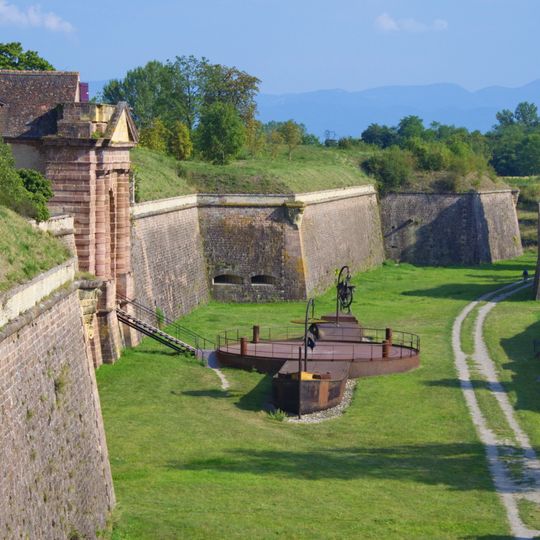
The ramparts can be walked on foot; a metal staircase on the inner face of the wall leads down into the ditch, where a circular metal platform with railings and iron wheels stands on the grass. The masonry walls curve and angle away, topped by a grassy slope. The town has no room to expand beyond the fortifications, so the walk follows the line of the walls.
The site holds more than a dozen protected buildings that all remain within the walls. This concentration makes it a particularly valuable example of French town planning from that period.
The community of curious travelers
AroundUs brings together thousands of curated places, local tips, and hidden gems, enriched daily by 93,783 contributors worldwide.