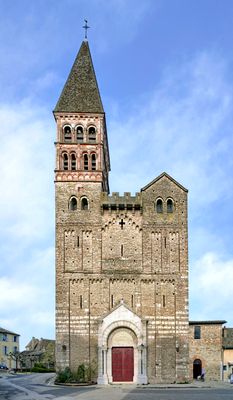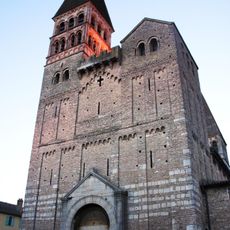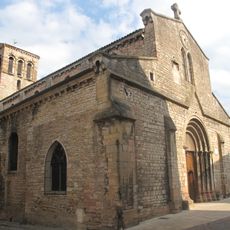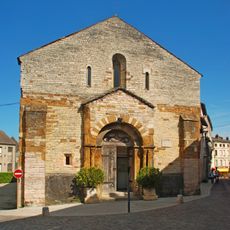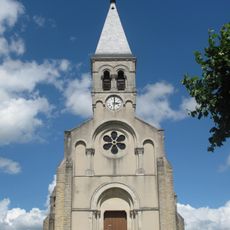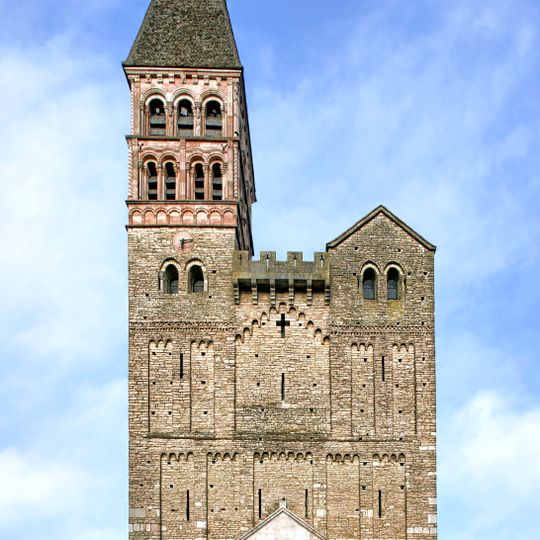
Saint-Philibert church of Tournus, Romanesque church in Tournus, France
Saint-Philibert is a Romanesque church in Tournus defined by its distinctive barrel vault construction with transverse arches. The interior features sturdy stone columns and a central nave supported by this innovative structural method.
A church of the late 9th century was destroyed by Hungarian raids in 937; a new building followed after 949, and after a fire in 1007 repairs allowed a consecration in 1019. Around 1020/30 the west narthex was begun, and around 1070–80 the nave was vaulted with transverse barrels. The crossing tower and choir were renewed around 1100, with work continuing past the mid-12th century.
The name Tournus derives from the martyr Valerian, beheaded around 178 and buried on the site of the present crypt, where a sarcophagus is kept. In 875 the monks of Noirmoutier brought the relics of Saint Philibert here, and the church keeps both patrons. On the arcade toward the nave stands a relief of a bearded man with a hammer, inscribed "Gerlannus", read as abbot or master builder.
The church stands a short walk from the Saône, with the west facade facing the former monastic buildings; the nave, transept and ambulatory follow one another in a single line. The crypt with its ambulatory and three radiating chapels lies beneath the choir, reached by steps, and the upper chapel of Saint Michael sits above the narthex. Allow time for both levels.
On the arcade between the narthex and the nave stands a relief of a bearded man holding a hammer, beside an inscribed plaque naming "Gerlannus", read as either the abbot or the master builder. The north tower was raised only in the 12th century, while the south tower still ends in a low stump.
The community of curious travelers
AroundUs brings together thousands of curated places, local tips, and hidden gems, enriched daily by 92,994 contributors worldwide.