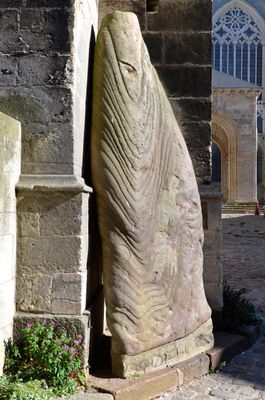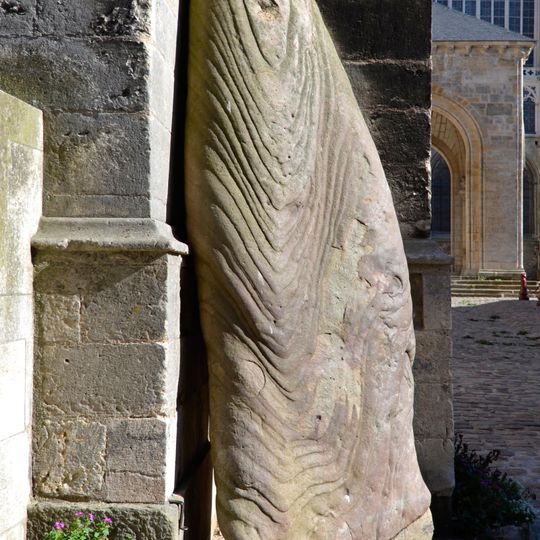
Pierre Saint-Julien, Prehistoric menhir near Saint-Julien Cathedral, Le Mans, France.
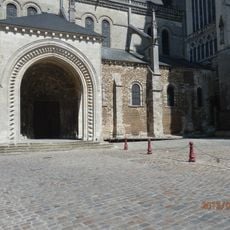
Pierre Saint-Julien is a 4.55-metre menhir of pink Eocene sandstone known as grès à Sabals, set against the wall at the south-eastern corner of the Romanesque west facade of Le Mans Cathedral. Its surface is greyish-brown and granular, crossed by deep wavy grooves in closely spaced parallel curves; the slab narrows slightly toward the top and widens at the base. A cupule near the centre is worn smooth.
The menhir was moved to its current location in 1778 after an older dolmen known as Pierre au Lait was destroyed. In 1889, the monument received official protection status, underscoring its importance to the city.
The central cavity in the stone has been worn smooth by local women over centuries, who touched it believing it would enhance their fertility. This practice shows how deeply people connected this place to their personal hopes.
The stone stands freely accessible outdoors beside the cathedral, so you can visit it at any time without needing a ticket. The monument sits in a busy part of the city where it is easy to find and can be combined with a visit to other nearby attractions.
The stone's many nicknames — pierre au lait, goutte de lait, pierre de sang, caillou de Gargantua, pierre des païens — record different readings of it over time, from a corruption of pierre lée (raised stone) to a site of executions. Its wavy surface grooves come from the sandstone's intra-sedimentary formation, which tradition reads as a woman's drapery.
The community of curious travelers
AroundUs brings together thousands of curated places, local tips, and hidden gems, enriched daily by 92,894 contributors worldwide.