Bicêtre Hospital, University hospital and listed historical monument in Le Kremlin-Bicêtre, France
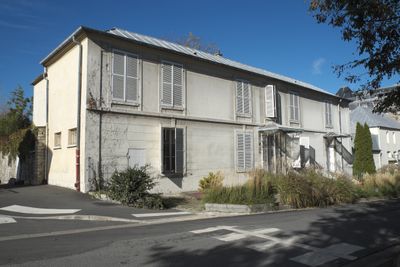
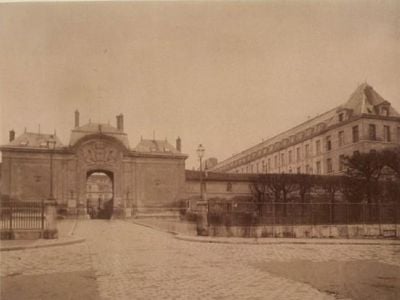
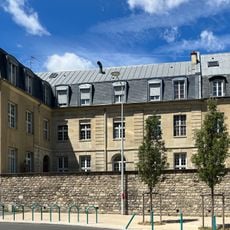
Bicêtre Hospital occupies the site of the 17th-century hospice at 78 rue du Général-Leclerc in Le Kremlin-Bicêtre. Its older pavilions by Le Mercier, the Saint-Jean-Baptiste and des Champs gates, the vaulted passage and Le Grand Puits are protected as monuments historiques. A new hospital-university centre designed by architect André Bourdon was delivered in 1981.
Construction began in 1634 for a planned military hospital; with Vincent de Paul's help it opened in 1642 as an orphanage and joined the Hôpital Général de Paris in 1656. It later served as a state prison, where the Marquis de Sade was held in 1781, and as an asylum where Philippe Pinel introduced humane treatment in 1793. Renamed Hospice de la Vieillesse Hommes in 1823 and Hospice de Bicêtre in 1885, it became a university hospital of the AP-HP in 1962.
The name Bicêtre derives from a castle that once stood on the site. The grounds still hold the Saint-Jean-Baptiste gate, the porte des Champs, a vaulted passage, wooden door leaves and Le Grand Puits, all protected as monuments historiques since 1962. The site is also called the "site of 100 ghosts".
The hospital is at 78 rue du Général-Leclerc in Le Kremlin-Bicêtre, 4.5 km from central Paris. Metro line 7 stops at Le Kremlin-Bicêtre and line 14 at Hôpital Bicêtre; RATP buses 47, 125, 131, 186 and 323 also serve the site. The grounds hold both 17th-century pavilions and a 1981 hospital complex, so ask at reception which building you need.
For much of its history, the place was not a regular hospital but housed orphans, prisoners, and psychiatric patients all at the same time in different sections. This unusual mix meant very different populations lived and were cared for within the same walls.
The community of curious travelers
AroundUs brings together thousands of curated places, local tips, and hidden gems, enriched daily by 94,453 contributors worldwide.