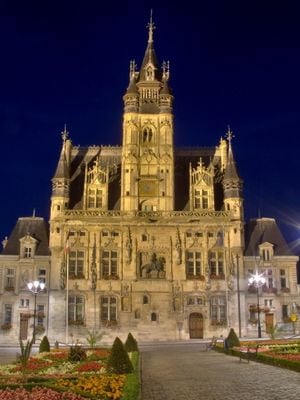
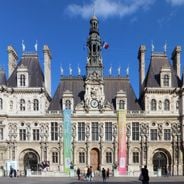
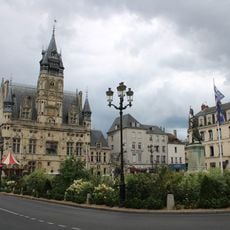
Town hall of Compiègne, Gothic town hall in Compiègne, France
The Town Hall of Compiègne is a Gothic structure featuring ornate stone facades with pointed arches, detailed sculptures, and carefully crafted stone elements. The symmetrical composition and intricate decorative details cover all exterior surfaces and dominate the appearance of the central square.
Begun in 1490 on two houses bequeathed to the town by Jean Loutrel in 1397, the building was entrusted around 1504-1505 to master mason Pierre Navyer, known as Pierre de Meaux. The aldermen first met in the great hall on 17 January 1513, and work continued until 1530. Classified as a monument historique in 1840 after Prosper Mérimée's intervention, it was restored between 1854 and 1882 under plans by Viollet-le-Duc.
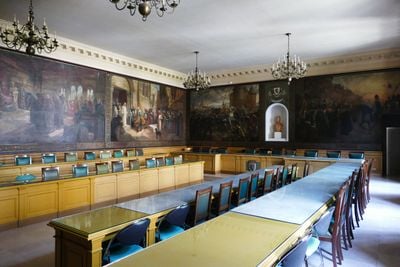
The building still houses the municipal administration and the tourist office. In May 1923 the Fêtes de Compiègne brought record crowds, and the "Reines du Muguet" were crowned at the town hall. In the former justice-of-peace room, now the council chamber, nine wall paintings by Raymond Fournier-Sarlovèze, finished in 1907, depict episodes of local history.
The town hall stands on Place de l'Hôtel de Ville, which was rebuilt after the Second World War by architect Jean Philippot; the square is paved and open, with the 1880 Joan of Arc statue at its centre. The building still houses the municipal administration and the tourist office, so visitors enter for information rather than for a museum visit. The facade was cleaned and rearranged between 1978 and 1980.
The equestrian statue in the facade niche is not medieval: it depicts Louis XII, the king reigning when the hall was built, and was cast in bronze by Henri Alfred Jacquemart in 1869. It replaced a Louis XIV statue by Gilles Guérin (1655) that revolutionaries tore down.
The community of curious travelers
AroundUs brings together thousands of curated places, local tips, and hidden gems, enriched daily by 93,662 contributors worldwide.