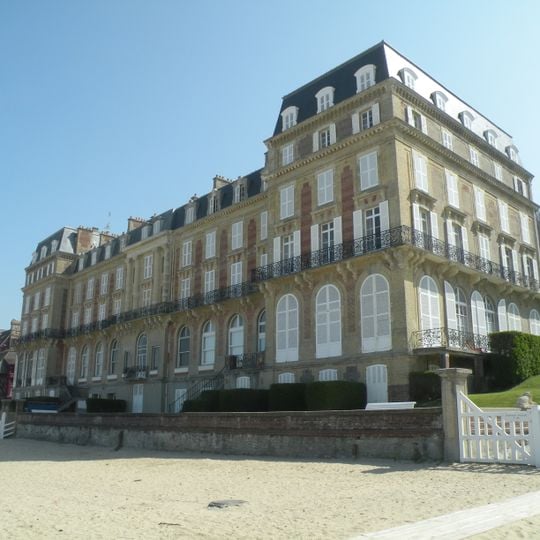
Hôtel des Roches Noires, Second Empire hotel monument in Trouville-sur-Mer, France.
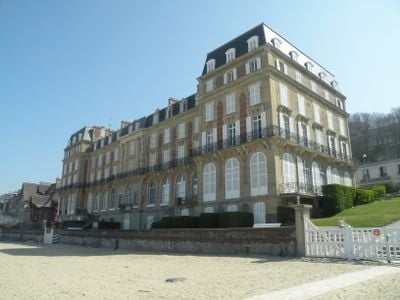
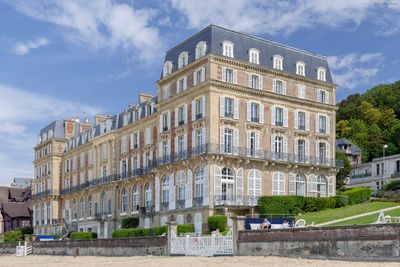
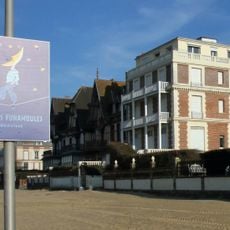
Hôtel des Roches Noires is a Second Empire former luxury hotel on the beach at Trouville-sur-Mer. Its lower facade is pale stone with arched windows, while the upper floors are red brick with white-framed rectangular windows; black wrought-iron balconies run along the middle levels beneath a steep dark roof with dormer windows. The long, angled front has wings extending left and right, and a white gate on the right opens onto a grassy area with dense green shrubs.
The hotel was the second grand luxury hotel built on this stretch of the Normandy coast. Architect Alphonse-Nicolas Crépinet designed it with 75 rooms; it opened on 15 July 1866 and had grown to 300 rooms by 1913, with electric lighting from 1904. In 1924 Robert Mallet-Stevens partly renovated it, turning the entrance hall into an Art Deco showcase. It closed in 1949 and was sold as private apartments.
Marguerite Duras bought apartment no. 105 in 1963 and spent every summer there until 1994, writing works such as L'Amant and Emily L. and filming India Song on site. She dined almost nightly at table no. 310 of the brasserie Le Central, where she took notes on the tablecloth and ate oysters.
The former hotel was divided into private apartments after 1949, so the interior, including the Art Deco entrance hall, is not open to visitors. The exterior can be seen from the beach and the street; the white gate with its red-and-white sign stands at the base of the corner facade.
Monet painted the hotel in 1870, the summer before the Franco-Prussian War, but could not afford to stay there: he lodged modestly with his family at the Hôtel de Tivoli and left the terrace each evening. The canvas, donated to the French state in 1947, has hung in the Musée d'Orsay since it opened in 1986.
The community of curious travelers
AroundUs brings together thousands of curated places, local tips, and hidden gems, enriched daily by 93,056 contributors worldwide.