Donjon de Vire, Medieval keep in Vire, France
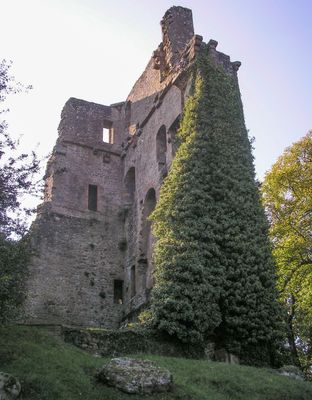
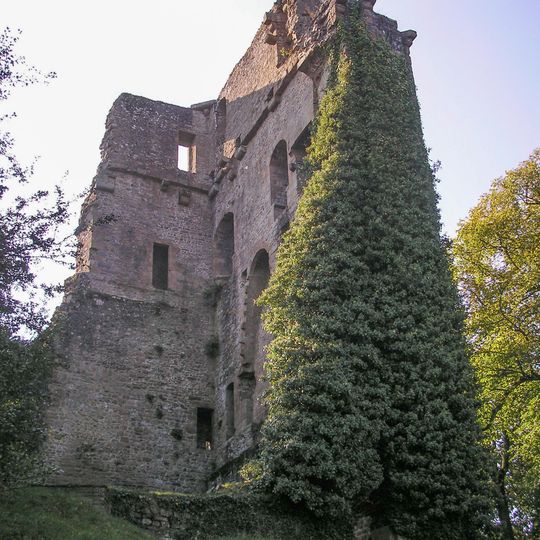
The Donjon de Vire is a medieval keep standing on a rocky elevation above the Vire river, with remaining sections of its original walls and supporting buttresses still visible. The structure now sits within a town park that covers the grounds of the former castle complex.
Henry I, duke of Normandy and king of England, built or rebuilt the castle around 1123 to shield the duchy's south from Angevin, Maine and Breton incursions. The keep was a quadrangular Romanesque tower, 14 by 13.40 metres outside. Louis XIII's 1626 Nantes declaration led to demolition from 20 April 1630; work went on for thirty years, leaving only two wall sections, further damaged by a collapse in 1802.
The name Vire comes from the river below the rock, and the town grew around the castle's protection before it had walls of its own in the 13th century. The esplanade of 98 by 160 metres was laid out as a promenade in the 19th century, so the former fortress grounds are now a walking space above the river meander.
The keep stands on a granite and gneiss spur above a tight bend of the Vire, about 200 m south of Notre-Dame church, in the centre of Vire. The 98 × 160 m esplanade of the former castle was laid out as a promenade in the 19th century. The ground is uneven around the battered base and broken top, so watch your footing.
The keep's surviving north wall was its thickest, at 2.30 metres, while the south wall measures 2.10 metres. A north-south dividing wall split the interior in two, and the floors rested on timber beams set into the east and west walls. The entrance was at first-floor level, above a blind ground floor.
The community of curious travelers
AroundUs brings together thousands of curated places, local tips, and hidden gems, enriched daily by 93,541 contributors worldwide.