Château de Cieurac, Medieval castle in Cieurac, France.
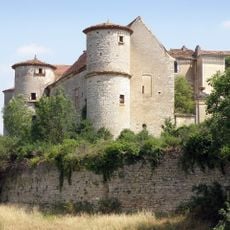
Château de Cieurac stands in the commune of Cieurac in the Lot department. The present building was raised on the remains of a 13th-century fortified castle, whose vestiges survive at the north and south ends of the main dwelling. Its light grey ashlar walls carry tall windows divided into four panes by stone mullions and transoms, a carved stone medallion above the central window, and a red-tiled hipped roof with three chimneys, the middle one capped by a steep pyramidal roof.
The present château stands on the remains of a 13th-century fortress, of which vestiges survive at the north and south ends of the main building. In 1487, after royal troops destroyed the Cardaillac castle at Saint-Cirq-Lapopie, Raymond de Cardaillac began rebuilding here shortly before his death in 1501; his son Jean-Jacques continued the work. In 1629 the castle passed to a cousin, Jacques Dayrac de Gardemont, and in June 1944 the SS Das Reich division set it on fire, destroying the roof, the ceilings listed in 1938, the furniture and the archives.
The château takes its name from the village of Cieurac in the Lot, held by the Cardaillac family, co-lords of Cardaillac and Saint-Cirq-Lapopie. In February 1503 Jean-Jacques de Cardaillac married Jeanne de Peyre, and her coat of arms was carved on the facade beside his. The seigneurie passed by marriage to the Godailh of Montauban in 1664, then by inheritance to the Dulac family.
The castle stands in the commune of Cieurac in the Lot department, at coordinates 44.36990, 1.52190. It was classified as a monument historique on 2 June 1938. After the June 1944 fire, a temporary roof was installed in 1950 and a temporary staircase in 1956; the building is private property, so visitors view it from outside.
The 13th-century fortress survives only as vestiges at the north and south ends of the main building; the rest was rebuilt from about 1501 by Raymond de Cardaillac, then continued by his son Jean-Jacques, whose arms and those of his wife Jeanne de Peyre were carved on the facade in 1503.
The community of curious travelers
AroundUs brings together thousands of curated places, local tips, and hidden gems, enriched daily by 94,658 contributors worldwide.