Église protestante de Munster, Protestant church in Munster, France
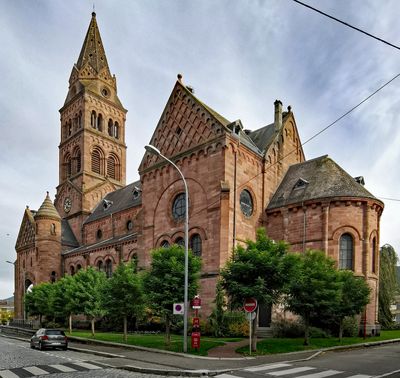
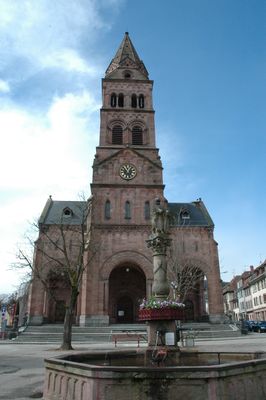
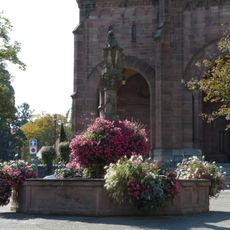
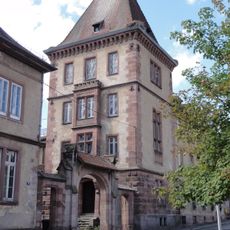
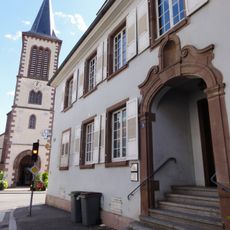
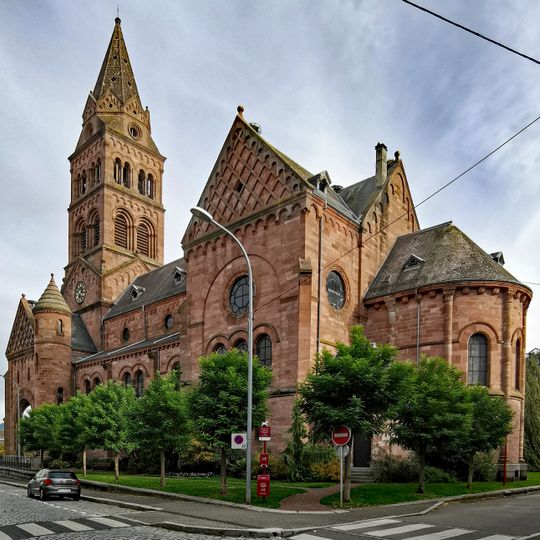
The Église protestante de Munster is a Neo-Romanesque church built of red sandstone ashlar, with a three-aisled basilica plan, a transept, an apse and an open three-part entrance porch. A tall tower with a steep pyramidal spire and clock faces rises on the left; the main body has a steep patterned roof and an apse-like section with tall arched windows and rose windows.
Construction began in 1867 under architect Frédéric-Louis de Rutté and was completed in 1873. The building's completion resolved decades of tension between different religious communities in the region.
The church belongs to the Protestant Church of the Augsburg Confession of Alsace and Lorraine. Its name recalls the long shared use of Saint-Léger: from 1686 the parish church was divided between both confessions under the simultaneum. The 1854 decoration of that shared church for the Immaculate Conception prompted the Protestants to build their own.
The church stands on the site of the former Protestant presbytery, southwest of the market square, in the centre of Munster. Reaching it meant demolishing several houses, and that preparatory work took seven years before construction was awarded in 1867. The deep round-arched portal is framed by concentric moldings.
The first organ, built by Eberhard Friedrich Walcker, was dedicated on 23 December 1873 and praised by Albert Schweitzer as one of the finest instruments in Alsace. Dismantled at the start of the First World War, it was replaced in 1924–1927 by an instrument from Georges Schwenkedel of Strasbourg, enlarged with a Rückpositiv in 1954 and rebuilt by Muhleisen in 1984–1985.
The community of curious travelers
AroundUs brings together thousands of curated places, local tips, and hidden gems, enriched daily by 94,128 contributors worldwide.