Grottes du Razet, cave in France
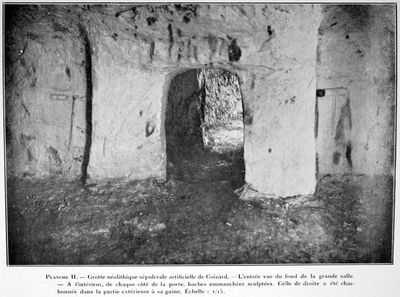
The Grottes du Razet are hypogea cut into a south-facing chalk slope at Coizard-Joches, forming a late Neolithic necropolis. Up to about fifty chambers were dug in parallel rows, each with a south or southeast entrance, an antechamber and a main room. Only hypogea no. 23 and no. 24 remain accessible; the others were backfilled.
The chambers were dug from the late Neolithic into the Bronze Age over many generations and used for burials. Discovered by chance in 1842, the site was explored by Baron Joseph de Baye in 1872-1873 and officially protected as a historical monument in 1926.
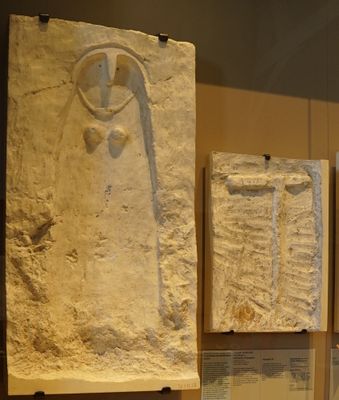
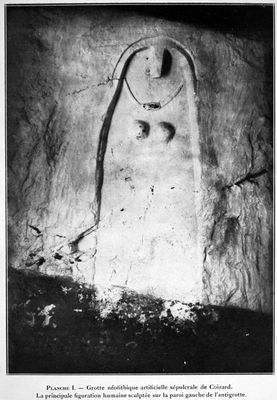
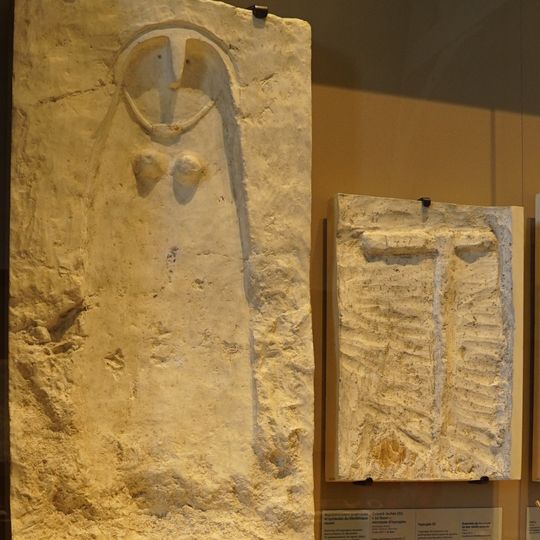
The name "grottes du Razet" is the popular one; scholars call the site a necropolis of hypogea. The female relief in chamber 23 was nicknamed "la gardienne des tombeaux" (guardian of the tombs) by Pierre Favret, who drew up plans of the chambers with J. Prieur between 1935 and 1938. The figure's necklace was compared to the Bragassargues stele in the Gard.
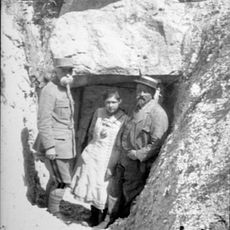
Only hypogea 23 and 24 remain open; all the others were backfilled. Both are reached by descending, respectively 2.75 m and 3.80 m, into low chambers whose ceilings are about 1.10 to 1.30 m high in the antechambers, so expect to crouch. The openings face south or southeast on a hillside.
Chamber 23 preserves a rare carved relief of a female figure, possibly a goddess or guardian of tombs, with striking details like a headdress and necklace. Scholars debate whether this carving is original or was added later, making it an intriguing mystery of the site.
The community of curious travelers
AroundUs brings together thousands of curated places, local tips, and hidden gems, enriched daily by 94,593 contributors worldwide.