Pont aqueduc de la Canaù, Historic aqueduct bridge in Cavaillon, France.
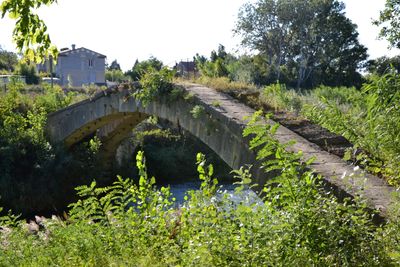
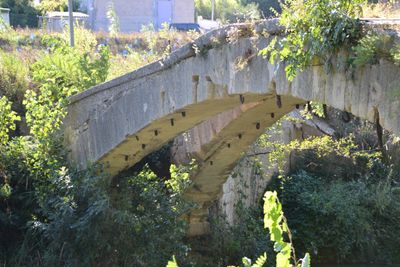
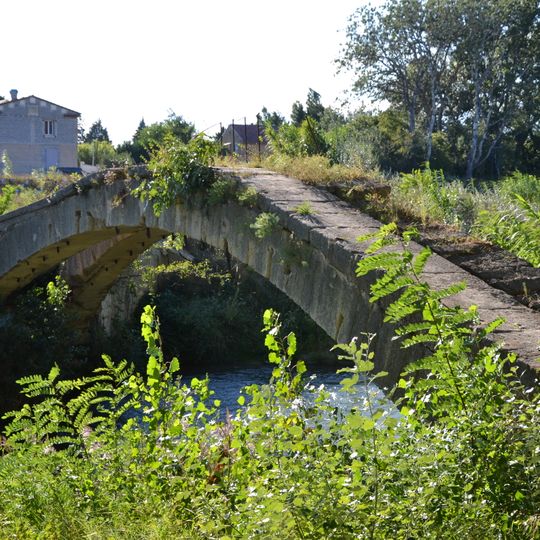
Pont aqueduc de la Canaù is a stone aqueduct bridge over the Coulon near Cavaillon, built of rough grey-brown masonry. It has two twin arches, each 22 metres long, meeting at a central support, with a maximum height of 8 metres. The arches carried a wooden channel suspended on iron hooks beneath them, and the top edge now serves as a parapet.
In November 1543, Bishop Pierre Ghinucci of Cavaillon authorised Jean Meynier, Marquis de Forbin d'Oppède, to divert canal water to his Rouret estate across the Calavon; Meynier funded the bridge near the Vignères hamlet, attributed to Adam de Craponne. In 1921, after repeated flood blockages, the original wooden conduit suspended under the arch was replaced by a siphon beneath the riverbed. The stone structure survived the 1994 flood, was classified as a monument historique on 18 August 2011, and was restored in 2024.
The bridge takes its name from the Canaù canal, the Saint-Julien branch it carries over the Coulon. Its two twin arches, 22 metres long and up to 8 metres high, were spaced apart at the banks and joined at their centre. The wooden channel hung from iron hooks beneath the arch and could be rebuilt after floods more easily than the stonework.
The bridge is easily accessible from outside and can be viewed from several vantage points along the river. It helps to have a map of Cavaillon, as the structure sits somewhat away from the main streets.
The bridge originally had a wooden channel that carried water across the river before pipe systems were later installed. This hybrid design was a practical solution that combined water transport with structural support.
The community of curious travelers
AroundUs brings together thousands of curated places, local tips, and hidden gems, enriched daily by 93,896 contributors worldwide.