Quai Pierre Scize, riverfront quay in the 5th and 9th arrondissements of Lyon, France
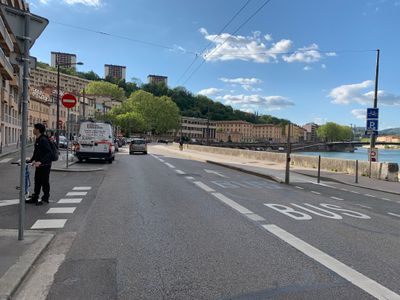
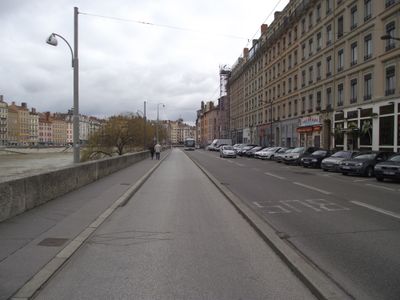
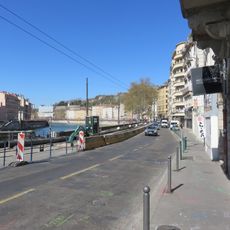
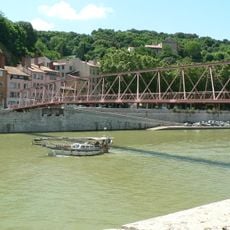
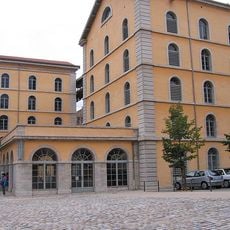
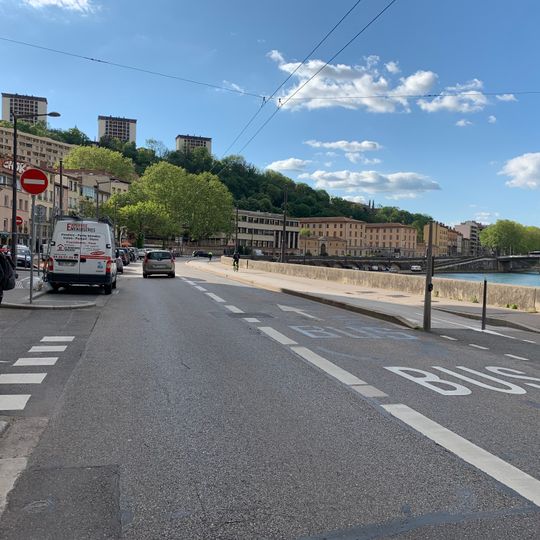
Quai Pierre Scize is a 1.18 km riverfront road along the right bank of the Saône in Lyon's 5th and 9th arrondissements, from the montée de l'Observance to place Gerson. It passes beneath the passerelle Saint-Vincent and the passerelle de l'Homme de la Roche. The paved roadway has marked bus lanes and is bordered by a raised stone wall.
The name comes from the "Pierre Scize", a granite outcrop of the Massif Central cut back in Antiquity to open a passage; the castle of Pierre Scize was later built on its levelled spur and destroyed at the Revolution. The quay itself was built from 1811 to 1828, and in 1854 the quays du Bourneuf, du Puits de Sel and de la Peyrollerie were merged under the name quai Pierre Scize.
The name comes from the Pierre Scize, a granite outcrop of the Massif Central that once jutted into the Saône and was cut back in antiquity to make way for a road. The quay appears in Bertrand Tavernier's 1974 film L'Horloger de Saint-Paul, which was shot here.
The quay runs about 1.18 km along the right bank of the Saône, from place Gerson and the Saint-Vincent footbridge upstream to the montée de l'Observance. It passes two footbridges, Saint-Vincent and l'Homme de la Roche, and the Feuillée bridge stands about 128 m from its eastern end. The roadway carries marked bus lanes, so walkers share space with traffic.
The name comes from the "Pierre Scize", a granite outcrop of the Massif Central that once jutted into the Saône and was cut back in Antiquity to open the passage the quay follows. The château de Pierre Scize stood on the levelled spur above until its destruction during the Revolution. A scene of Bertrand Tavernier's 1974 film L'horloger de Saint-Paul was shot on the quay.
The community of curious travelers
AroundUs brings together thousands of curated places, local tips, and hidden gems, enriched daily by 93,126 contributors worldwide.