Hôtel de Cavoye, Private mansion in 7th arrondissement, Paris, France
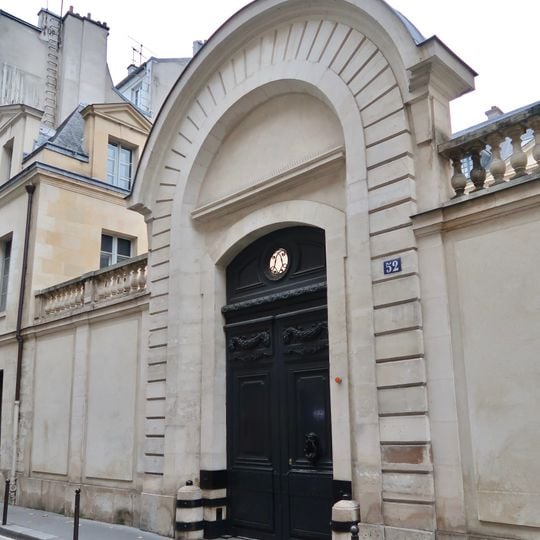
The Hôtel de Cavoye at 52 rue des Saints-Pères is a 17th-century private mansion. Its street entrance is a tall stone archway with stepped, banded masonry framing dark double doors. Above the doors, a black panel holds a round white clock with black hands and numerals; carved dark garlands decorate the door tops, and a blue enamel plaque reads "52". The arch rests on two short stone posts painted with black and white horizontal stripes.
Built in 1630 for Paul Bailly, chaplain to the king, the mansion was reportedly occupied in 1640 by the exiled Dutch jurist Hugo Grotius. Louis Oger de Cavoye bought it in 1679 and had it decorated by Jules Hardouin-Mansart and Antoine Lepautre; in 1686 Daniel Gittard rebuilt the main building and street portal. It was listed as a monument historique on 8 June 1949.
The name comes from Louis Oger de Cavoye, who bought the house at 52 rue des Saints-Pères on 18 July 1679 from Marie-Sidonia de Lénoncourt and had it embellished. He died there on 3 February 1715. The blue enamel plaque reading "52" beside the doors marks the address.
The mansion stands at 52 rue des Saints-Pères in the 7th arrondissement, on the Left Bank near the Seine. It is a private residence, so the striped stone posts and the clock above the doors are seen from the street. The nearest metro stop is Rue du Bac on line 12.
The street portal seen today was rebuilt in 1686 by Daniel Gittard for the Marquis de Cavoye and his wife Louise Philippe de Coëtlogon. Its stepped stone arch, black clock panel and doors carved with dark garlands are the work of that campaign, not the 1630 house.
The community of curious travelers
AroundUs brings together thousands of curated places, local tips, and hidden gems, enriched daily by 93,847 contributors worldwide.