Grande Tombe de Villeroy, National necropolis in Chauconin-Neufmontiers, France
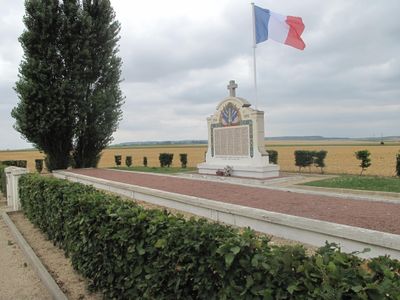
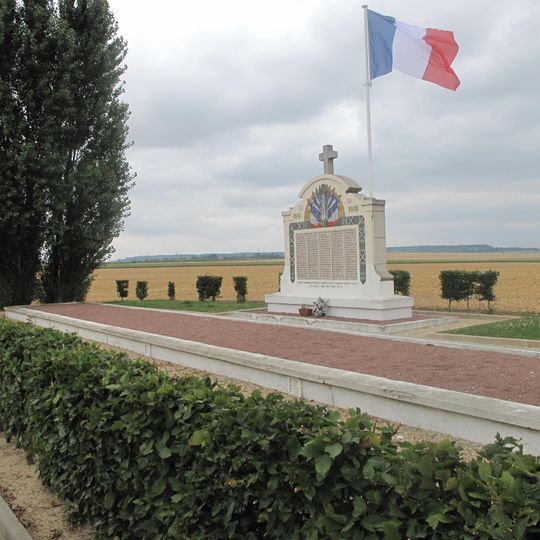
The Grande Tombe de Villeroy is a national necropolis in Chauconin-Neufmontiers, an ossuary holding 133 French soldiers killed on 5 September 1914. Its monument, designed by architect Henry Faucheur and built in 1932 with marble worker Lelu and mosaicist Louis Barillet, is a wide rectangular stone stele rounded at the top, faced with mosaic French flags and inscribed with the names of 99 identified soldiers. A low base carries a plaque with the dates 1914 and 1918, and a French flag flies behind it.
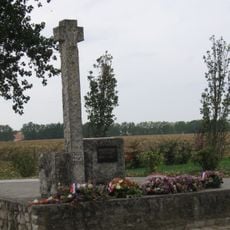
On 5 September 1914, the 19th company of the 276th Infantry Regiment reached Villeroy and came under enemy fire; Lieutenant Charles Péguy was killed by a bullet to the forehead. The 133 soldiers who fell were buried on 7 and 8 September at the site. The monument erected there was desecrated in 1920; the present one dates from 1932, and the Péguy stele from 1936, moved to Villeroy in 1992.
The monument is known as the "Grande Tombe de Villeroy" after the nearby village, though it stands in Chauconin-Neufmontiers. Its mosaic, made by Louis Barillet, shows French flags above the names of 99 identified soldiers. A dedication names the 231st, 246th and 276th infantry regiments and the 55th and 56th divisions. Ceremonies are held here each September.
The site is accessible via departmental road 129 between Villeroy and Chauconin-Neufmontiers, roughly 10 kilometers from Meaux. The burial ground is best experienced on foot since the area is compact and allows you to walk the perimeter and read the names displayed.
The ossuary in front of the monument holds 32 soldiers and 2 sergeants who were never identified. The monument itself, designed by architect Henry Faucheur, was made by marble worker Lelu and mosaicist Louis Barillet, whose mosaic of French flags tops the stele.
The community of curious travelers
AroundUs brings together thousands of curated places, local tips, and hidden gems, enriched daily by 94,326 contributors worldwide.