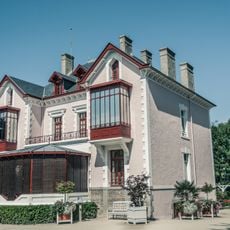
Casino de Granville, Historical casino in Normandy coast, France
Casino de Granville is a gaming establishment inaugurated in 1911, built on a rocky promontory at the foot of the beach. Its stuccoed facade, pale yellow with brown roofs, has two square belvedere towers with pointed roofs and open arcaded upper levels, linked by a pergola. The design mixes Beaux-Arts academicism with the picturesque character of small Norman towns.
The casino was created in 1909 by American financier Frank Jay Gould and Belgian promoter Georges Bonheur, with Parisian investors, to replace the salon des bains de mer. Architect Auguste Bluysen, also author of the casinos of Le Touquet, Algiers and Vittel, designed it in a compromise between Beaux-Arts academicism and the picturesque character of small Norman towns. It opened on 15 July 1911. In 1925 Bluysen remodelled it, replacing the wooden pergola with a concrete one and reworking the restaurant and reception room in Art Deco style. The facades, roofs, two campaniles, pergola and former entrance hall were inscribed as monuments historiques on 18 May 1992.
The casino's name is displayed in capitals on the curved corner of its left section, above the sea wall. Inside, the former entrance hall now serves as the gaming room, and its decoration is protected along with the facades, roofs, two campaniles and pergola since 1992. The theatre, enlarged in 1957, reopened in 1991 as the Théâtre de l'Archipel.
The casino stands on a terrace at the foot of the beach, below the rocky promontory it leans out from, so it is reached by walking down from the town rather than through a city-centre entrance. Its listed facades, roofs, two campaniles and pergola face the sea, and the former entrance hall now serves as the gaming room.
The casino's two square towers with open belvedere tops and pointed brown roofs, joined by a pergola, are said to recall Indian palaces. The 1925 reworking by Auguste Bluysen replaced the wooden pergola with a concrete one and gave the restaurant and reception room their Art Deco interiors. The facades, roofs, both campaniles, the pergola and the former entrance hall were listed as monuments historiques on 18 May 1992.
The community of curious travelers
AroundUs brings together thousands of curated places, local tips, and hidden gems, enriched daily by 94,136 contributors worldwide.