Polissoirs de Souppes-sur-Loing, Neolithic polishing stones in Souppes-sur-Loing, France.
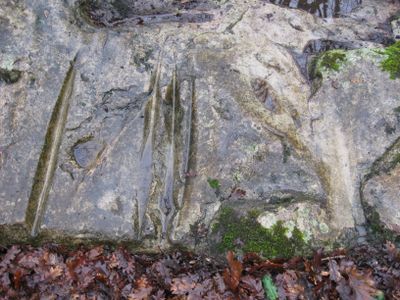
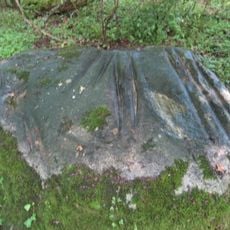
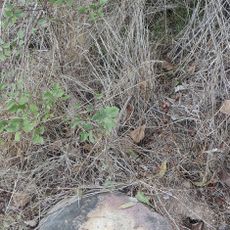
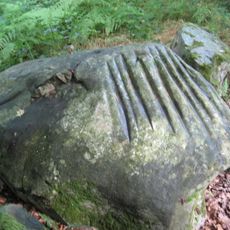
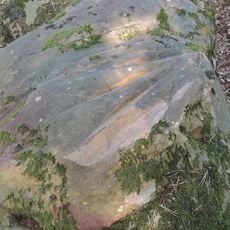
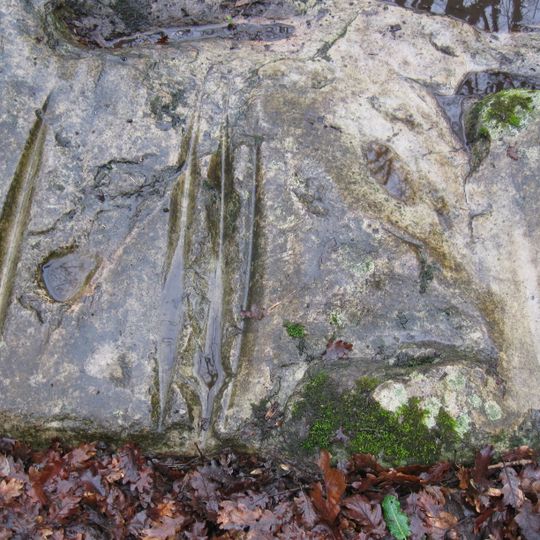
The polissoirs de Souppes-sur-Loing are a group of seven sandstone polishing stones at the Gué de Beaumoulin. The largest visible surface is a flat grey-beige slab of Fontainebleau sandstone, mottled with dark patches and moss, into which deep, smooth, parallel troughs have been worn. Fallen leaves border the stone at its base.
These polishing stones were used during the Neolithic period by people who regularly sharpened and maintained their tools at this location. The archaeological importance of the site led to its recognition as a protected historical monument in 1889.
The site takes its name from the Gué de Beaumoulin, a former ford on the Loing. The seven sandstone polissoirs were reported in 1874 by a stonecutter named Remauger, and the first six were listed as monuments historiques in 1889; the seventh was only found and described in 1972 by J. Soulier. Visitors can pick out the deep, smooth parallel troughs worn into the flat grey-beige surface, with moss and fallen leaves around them.
The site is located at 9002 Le Cocluchon and can be reached via the D607 road. The nearest train station is Souppes-Château-Landon, from which visitors can make their way to the stones on foot or by other means.
The seventh polisher was only found and described in 1972 by J. Soulier, long after the first six were listed as monuments historiques in 1889. The set was first reported in 1874 by a stonecutter named Remauger. The stone is Fontainebleau sandstone, whose hard surface kept the grooves readable.
The community of curious travelers
AroundUs brings together thousands of curated places, local tips, and hidden gems, enriched daily by 93,153 contributors worldwide.