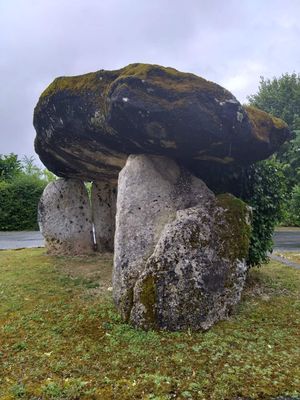
Dolmen de Peyrelevade, Dolmen in Brantôme en Périgord, France
The dolmen de Peyrelevade, also called La Pierre Levée or dolmen du Camp-de-César, stands east of Brantôme, about 50 m north of the D 78. Its burial chamber is unusually high at 2.50 m, roofed by a sandstone slab 5 m long, 2.90 m wide and 1.40 m thick, resting on three dressed orthostats plus a late 19th-century support pillar.
The dolmen at Peyrelevade was reported as early as 1818 by the archaeologist François Jouannet. It was classified as a monument historique in 1889, and at the end of the 19th century a supporting pillar was added to consolidate the chamber. In the early 20th century it appeared on many postcards.
The names Peyrelevade and La Pierre Levée ("the raised stone") refer to the slab lifted on its supports; a third name, dolmen du Camp-de-César, links it to Caesar's camp. In the early 20th century the monument was a common subject of postcards, and Alain Beyneix calls it the best-known megalith in the Dordogne.
The dolmen stands east of Brantôme's town centre, about 50 m north of the D 78 (Avenue André Malraux) on Rue Peyrelevade, on the north bank of the Dronne. It belongs to the commune of Brantôme en Périgord and can be reached on foot from the town.
The slab is about 5 m long, 2.9 m wide and 1.4 m thick, resting on three dressed uprights plus a support pillar added at the end of the 19th century. Alain Beyneix calls it the best-known megalithic monument in the Dordogne. No archaeological finds are associated with it.
The community of curious travelers
AroundUs brings together thousands of curated places, local tips, and hidden gems, enriched daily by 93,014 contributors worldwide.