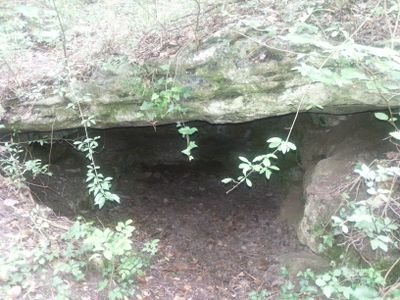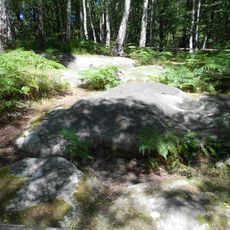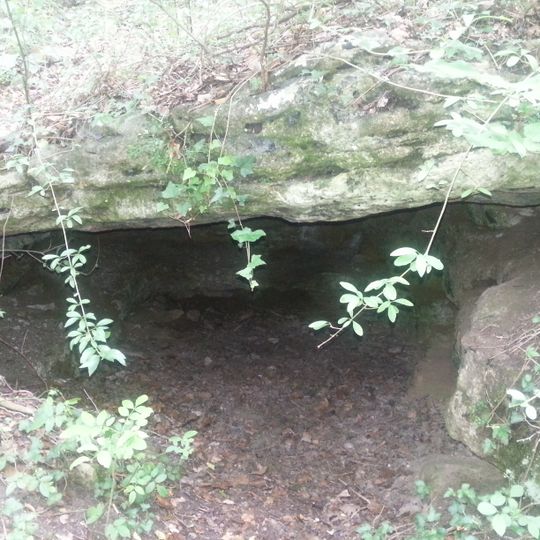
Dolmen du Trou à Morts, Neolithic burial site in Parmain, France.
The Dolmen du Trou à Morts is a Neolithic burial chamber cut into a soft limestone bench between two harder layers, almost at the top of a hill's western slope in Parmain. The oblong chamber measures 4.30 m long, 1.55 m wide at the entrance and 1.90 m at the back, with a ceiling 1 m to 1.35 m high. Only two vertical slabs remain of the antechamber that once extended it.
The site dates to the Neolithic period and was rediscovered around 1850 when excavation revealed bones and tools. These findings show that people used this location for burials over an extended time.
The name "Trou à Morts" (hole of the dead) is the name by which the cavity is known locally. The tomb was later used as a shelter, including by tramps in the 1850s and by residents sheltering from German aircraft during the First World War. Two vertical slabs, 1.45 m by 0.45 m and 0.70 m by 0.30 m, are all that remain of the megalithic antechamber.
The tomb lies near the top of the western slope of a hill between the Val de Nesles and the Ru de Jouy, about 2 km north of Parmain, reached on foot through the forest. The entrance opens west-north-east facing the slope, and the ceiling is only 1 m high at the entrance, rising to 1.35 m on the south side and 1.20 m at the back, so you must stoop throughout.
The chamber's ceiling runs from about 1 m at the entrance to 1.35 m on the south side and 1.20 m at the back, so an adult must stay bent throughout. The north and east sides were cut as a bench, and the dry-stone wall lining was removed when the tomb was converted into a shelter.
The community of curious travelers
AroundUs brings together thousands of curated places, local tips, and hidden gems, enriched daily by 92,953 contributors worldwide.