Abbaye de Mègemont, Cistercian abbey in Chassagne, France.
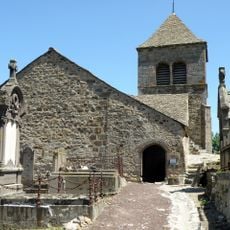
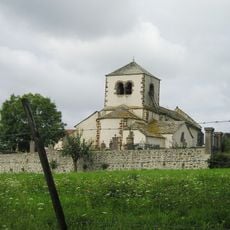
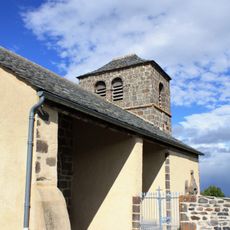
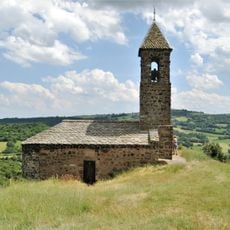
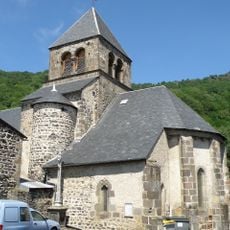
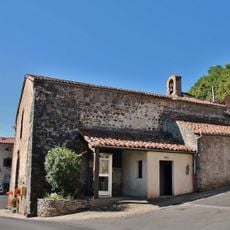
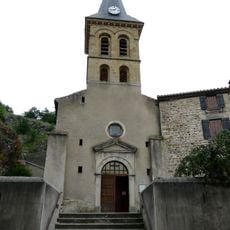
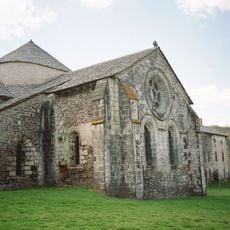
Abbaye de Mègemont is a Cistercian abbey in the Chassagne valley at about 870 metres elevation. Its 13th-century abbey church keeps only the choir and transept, the nave having been destroyed in the 20th century. The rough grey and brown stone facade has three tall narrow arched windows and a circular rose window, with a small cross at the roof peak.
Robert IV of Auvergne, first Dauphin of Auvergne, founded the Cistercian nunnery between 1199 and 1206, after the death of his wife Guillemette de Comborn in 1199, so that prayers could be said for her. In 1611 abbess Françoise de Nérestang moved the nine nuns and two lay sisters to La Bénisson-Dieu and the monks took their place at Mègemont. The monastery was dissolved in 1791 and sold as state property.
The name Mègemont derives from the Latin Medius Mons, "middle mountain". The abbey was a double site in a sense: in 1611 Abbess Françoise de Nérestang moved her nine nuns and two lay sisters to La Bénisson-Dieu, and the Cistercian monks of that house, led by her brother Claude, took their place here. After the Revolution the buildings served as a sheepfold.
The abbey stands in the Chassagne valley at about 870 metres, less than 700 metres west of the village of Chassagne. A friends' association has been restoring the church and remaining buildings since 1992, so parts of the site may be closed while work continues. The church is the main surviving medieval structure to look for.
The abbey church was used as a filming location for the 2004 film The Crimson Rivers 2: Angels of the Apocalypse. A restoration campaign led by an association of friends of the abbey began in 1992, focusing on the ruined remaining buildings, especially the church.
The community of curious travelers
AroundUs brings together thousands of curated places, local tips, and hidden gems, enriched daily by 93,858 contributors worldwide.