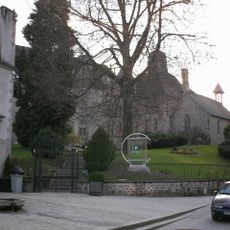
Église de la Nativité-de-la-Vierge de Glénic, Medieval church in Glénic, France.
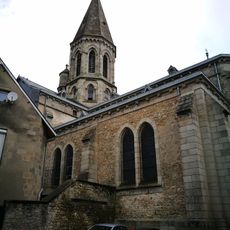
The Église de la Nativité-de-la-Vierge in Glénic has no bell tower; a bell hangs in its roof frame. The nave of four rib-vaulted bays ends in a five-sided apse, with two facing side chapels in the second bay. The west front pairs a light beige masonry tower with a steep dark reddish-brown tiled roof and a narrow arched window with a grille, beside an older lower section with a rounded turret.
The church was built from the late 11th to the early 12th century on the site of a Gallo-Roman mausoleum, later a Merovingian necropolis. In the 15th century, during the Hundred Years' War, it was fortified and enlarged: the nave was extended by two rib-vaulted bays, the raised choir was flanked by two turrets, and two bartizans were added. It was classified as a monument historique on 18 December 1989.
The wall paintings inside show biblical scenes from the 15th century, including the Fall of Adam and Eve, and were rediscovered in 1973. Visitors can still see these frescoes today on the interior walls.
The building is open to visitors and displays sarcophagi from the 7th century inside for examination. It was classified as a historical monument in 1989 and hosts concerts regularly.
A Gallo-Roman epitaph lintel was uncovered during archaeological excavations and is now displayed inside the church. This artifact reveals the long occupation history of the site before the medieval building was constructed.
The community of curious travelers
AroundUs brings together thousands of curated places, local tips, and hidden gems, enriched daily by 94,540 contributors worldwide.