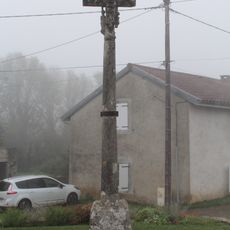
Château de Nanc-lès-Saint-Amour, Medieval fortress in Nanc-lès-Saint-Amour, France.
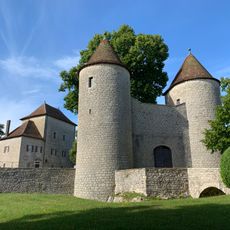
Château de Nanc-lès-Saint-Amour is a rectangular fortified house 24 metres long and 14 metres wide, three storeys high and facing south-east. A large round tower with a spiral staircase stands at the middle of the main facade, and the windows were fitted with mullions. Latrines open directly to the outside.
The 1308 franchise charter of Nanc does not mention a castle, but a 1434 document records Philip the Good confiscating the lordship from Antoine de Laye and granting it to chancellor Nicolas Rolin. The first maison forte on the present site likely dates from around 1400 and was built by a Laubespin; later work uncovered foundations and a stair cut into the rock.
The name Nanc comes from the fief held by the Laubespin family, whose member Odet signed the village's 1308 charter of franchise. The stronghold stood on the salt road from the Salins saltworks, a route linking the duchy and county of Burgundy. A fresco by Abbot Jules-François Moirod in the chapel of Nanc shows one of its square towers with crenellations.
The house stands in Nanc-lès-Saint-Amour, part of the commune of Les Trois-Châteaux in the Jura, on the old salt road from Salins. The main facade faces southeast, so the round tower and its arched door are best seen in morning light. The building is private; visitors view it from the grassy area beside it.
A fresco by Abbot Jules-François Moirod in the chapel of Nanc shows one of the square towers with crenellations, a detail no longer visible on the building itself. The 19th-century historian Rousset also recorded a house at a spot called en Palent, which collapsed around 1448 after a landslide; its castellan, Jean de Palent, is said to have moved into the other fortified house. No remains of it are known.
The community of curious travelers
AroundUs brings together thousands of curated places, local tips, and hidden gems, enriched daily by 94,743 contributors worldwide.