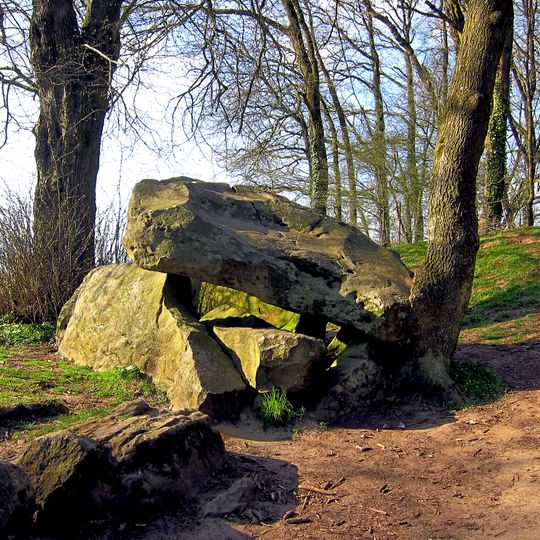
Table des Fées, Dolmen in Fresnicourt-le-Dolmen, Pas-de-Calais, France
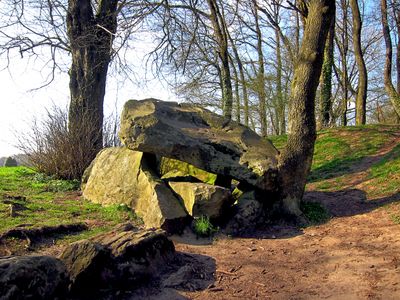
The Table des Fées is an ancient stone structure in the countryside of northern France, built from three upright stones supporting a large capstone. The capstone measures approximately 10 feet long (3 meters) and over 8 feet wide (2.5 meters), weighing about 10 tons, though part of it has tilted toward the northeast.
The dolmen dates back over 4000 years to the Neolithic period and received official protection as a historical monument in 1889. It was once part of a larger group of four dolmens arranged in a diamond shape connected by standing stones, most of which was destroyed in the 1800s when quarry workers extracted stone for road construction.
The name Table des Fées, "Fairies' Table", gave the commune of Fresnicourt-le-Dolmen the second part of its name. The monument is also known as an allée couverte, a covered passage, a term used by Adrien de Mortillet, Claude Burnez and Jean Arnal, while Auguste Terninck described it as a dolmen with a corridor.
The monument stands on bare, reddish-brown earth among trees and patchy grass, with a rounded boulder lying at the base to the left of the stones. The ground is uneven and moss covers parts of the blocks, so watch your footing. The site lies in the commune of Fresnicourt-le-Dolmen, in the Pas-de-Calais department.
The monument gave Fresnicourt-le-Dolmen its name: the commune was called Fresnicourt until a 1929 decree added "le-Dolmen" in reference to the Table des Fées. The capstone, about 3 m long, 2.5 m wide and 0.6 m thick, is estimated to weigh around 10 tonnes.
The community of curious travelers
AroundUs brings together thousands of curated places, local tips, and hidden gems, enriched daily by 93,009 contributors worldwide.