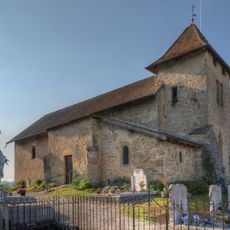
Château de Demptézieu, Medieval castle in Saint-Savin, France.
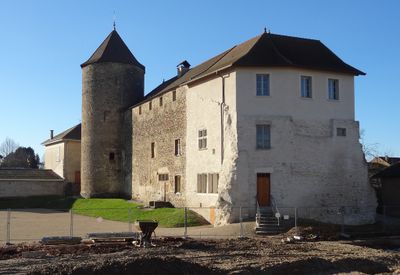
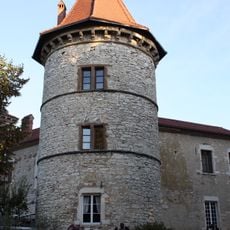
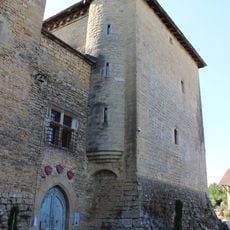
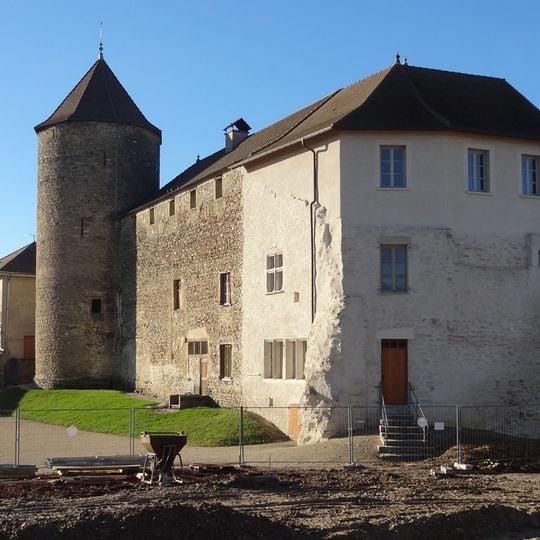
The Château de Demptézieu in Saint-Savin consists of a rectangular main building flanked at one corner by a round keep with arrow slits and a spiral staircase built into its walls. A richly carved hexagonal turret with mullioned windows dates from the 16th century. The surviving wing and tower are all that remain of a fortress that once had about fifteen towers linked by a 1.30-metre-thick, 800-metre enclosure wall.
The castle was built in the 12th century and became disputed territory during conflicts between Dauphine and Savoy, changing hands from Jean II of Vienne to Amadeus V of Savoy in 1314. This transfer reflected the broader power struggles reshaping the politics of this Alpine region.
The name appears in medieval acts as Dentesiaci or Denteysiaci, which survives in the hamlet's name. The oldest known castellan, Hugues de Demptézieu, held the castle from 1075 to 1080, and the land had earlier belonged to the abbots of Saint-Chef. In 1904 the building and its estate became communal property.
The castle stands in the heart of the hamlet of Demptézieu, south of Saint-Savin's central village, roughly equidistant from Ruy-Montceau and Bourgoin-Jallieu. The nearest railway station is Bourgoin-Jallieu, under four kilometres away. The building was communal property from 1904 and, according to the Petit Futé site in 2019, was undergoing restoration; its façades, roofs and the spiral staircase of the 15th-century hexagonal tower were listed as monuments historiques on 15 September 1954.
The hexagonal tower design is uncommon for castles of this region and period, as most towers were circular or square-shaped structures. This architectural choice may have offered defensive advantages, though its exact reasoning remains unclear to modern observers.
The community of curious travelers
AroundUs brings together thousands of curated places, local tips, and hidden gems, enriched daily by 94,024 contributors worldwide.