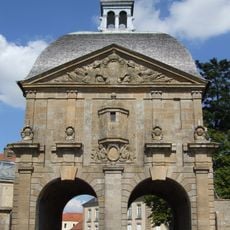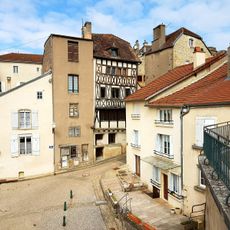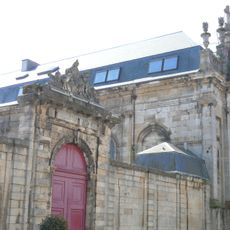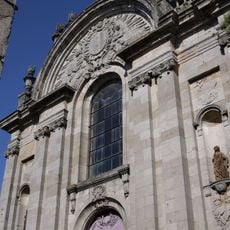
Fortifications of Langres, Medieval rampart in Langres, France
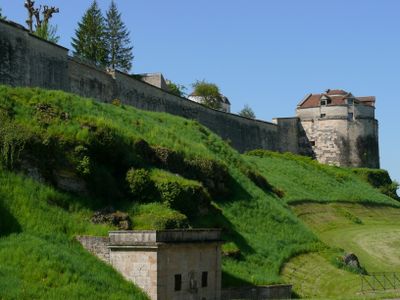
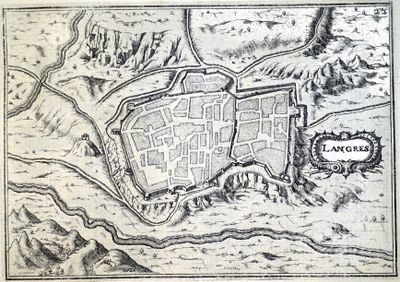
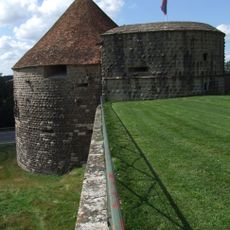
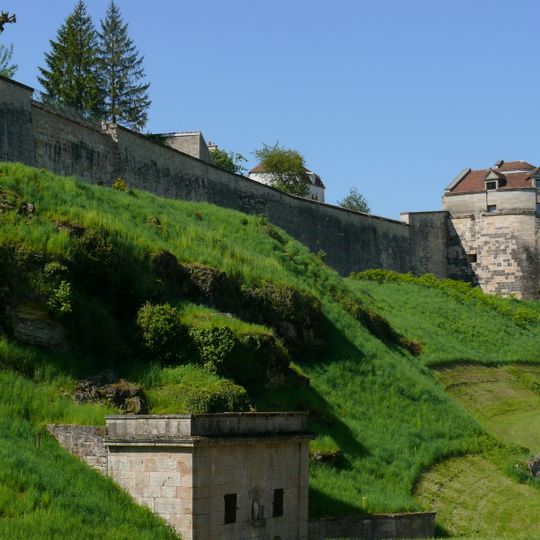
The enceinte of Langres is a fortification system that surrounds the town with walls extending several kilometers and includes defensive towers and bastions. The structure is built from pale limestone and displays different periods of reinforcement and modification.
After the Alamannic chief Chrocus killed Bishop Didier in 264, survivors built a wall across the northern part of the spur, 3.35 m thick, pierced by the Porte du Pain and the Porte Moab. The Gallo-Roman Marché arch, dating from about 20 BC, was incorporated into it. A southern wall followed at an unknown date, and in 1266 the Sous-Murs suburb was enclosed. Gilon de Tournus restored the walls, confirmed by a charter of Charles the Fat given at Schelestadt on 18 February 888.
The name Langres derives from the Gaulish Lingones, whose oppidum was called Andemantun. The Gallo-Roman arch of the Marché, built around 20 BC, was later built into the rampart near the Porte du Marché. The Porte du Pain and the Porte Moab were the two gates of the 3rd-century wall; the latter was demolished in July 1840.
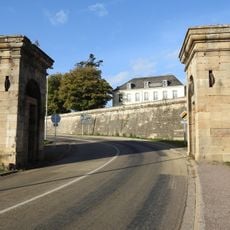
The ramparts run along the edge of the upper town on a spur between the Marne and the Bonnelle, so the ground falls away sharply on the outer side. The wall is entered through the gates that still cross it, among them the porte du Marché, where the Gallo-Roman arch of about 20 BC is built into the masonry. Sections of the 3rd-century wall survive near the rue Cardinal-Morlot and the rue Moab.
The Gallo-Roman arch of the Marché, raised around 20 BC under Augustus, still stands inside the later ramparts near the Porte du Marché. It is one of the oldest pieces of the fortification circuit, reused as part of the defensive line rather than left outside it.
The community of curious travelers
AroundUs brings together thousands of curated places, local tips, and hidden gems, enriched daily by 92,819 contributors worldwide.