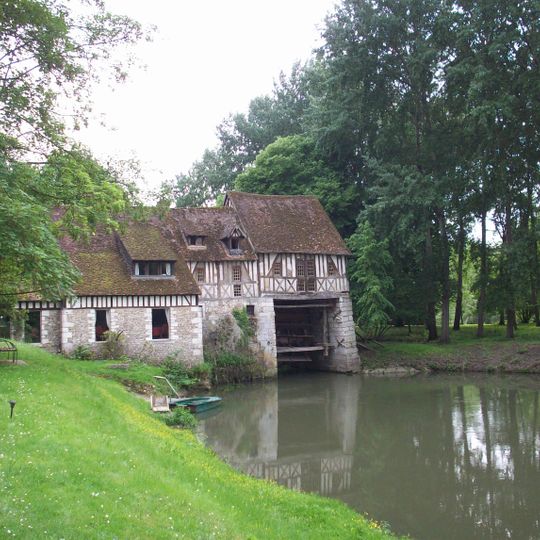
Moulin d'Andé, Historic watermill in Andé, France.
The Moulin d'Andé is a timber-framed mill built on two ashlar stone piers from the 15th century, with the present building dating to the mid-18th century. Its paddle wheel hangs beneath the floor, immersed in an arm of the Seine and raised or lowered by wooden screw jacks. The mill is followed by a row of half-timbered buildings, the first being the miller's house.
A mill may have stood here as early as the 12th century, supplying the garrison of Château Gaillard, but its existence is first documented in the early 15th century. The present building dates from the mid-18th century, while its two stone piers go back to the 15th. Milling stopped by 1875, after the Poses dam raised the Seine by 1.20 m. The mill and its mechanism were classified as a Monument Historique on 12 October 1995.
Since 1962, this mill operates as a cultural center where artists, musicians, and writers gather to create and present their works. The regular events and exhibitions make it a living meeting place for creative people from the region and beyond.
The mill stands north of Andé, over an arm of the Seine, reached from the village by road; the 15-hectare park is included in the protected site. The mill and its mechanism are classified monuments, so interior access depends on the cultural centre's residencies, concerts and seminars rather than on regular opening hours. Look for the two 15th-century stone piers beneath the timber frame and the sluice in the archway.
The mill's water wheel hangs beneath the floor, immersed in the river and raised or lowered by wooden screw jacks as the water level changes. This system, with its millstones, screw jacks, tie rods, shaft and large toothed wheel, survives largely in wood, making the mill a rare example of its kind in Western Europe.
The community of curious travelers
AroundUs brings together thousands of curated places, local tips, and hidden gems, enriched daily by 93,847 contributors worldwide.