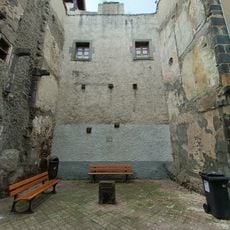
Remparts de Montferrand, Medieval fortifications in Montferrand, France.
The Remparts de Montferrand are the surviving walls of a trapezoidal enceinte built from the late 12th to the 16th century around the comtal town. The walls were 1.80 to 2 metres thick, with discharge arches separating piers every two to three metres, and were flanked by twenty-two semi-cylindrical and quadrangular towers. About 900 of the original 1,773 metres and thirteen towers remain, largely absorbed into later buildings; a curved semicircular projection of dark, irregular stones set in mortar survives above grassy ground.
The ramparts were built beginning in the 12th century to protect the town during conflicts between local counts and rival powers in the region. Over five centuries they served as a defensive barrier and were reinforced and modified as military threats and needs changed.
The fortifications are woven into the neighborhoods where people live, with residents passing by them daily or using the preserved towers as landmarks in their surroundings. The walls form a natural boundary that shapes how the city is organized and reminds everyone of the town's long past.
The walls are accessible on foot, with the most visible sections found along Rue Montplaisir and Rue des Fossés sous la Rodade where the stone structures are clearly exposed. Allow time to walk along the perimeter and view the fortifications from different angles to understand their layout.
Among the four main gates was a water gate through which a canal passed to bring drinking water into the town, making it an essential supply route. This feature shows how defensive needs were balanced with practical requirements for daily life.
The community of curious travelers
AroundUs brings together thousands of curated places, local tips, and hidden gems, enriched daily by 93,590 contributors worldwide.