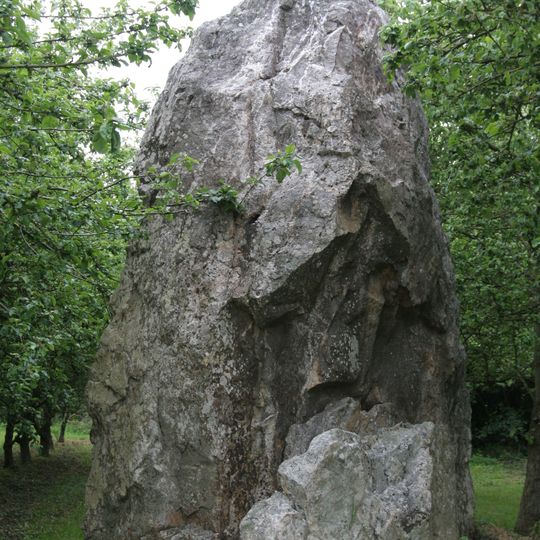
Dent de Gargantua, Neolithic menhir in Saint-Suliac, France.
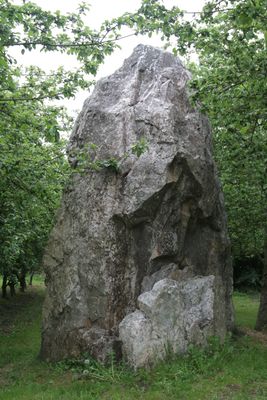
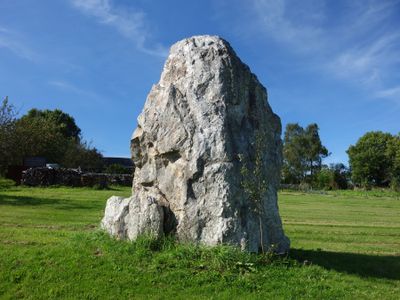
Dent de Gargantua is a white quartz menhir shaped like a four-sided obelisk, standing almost 5 m high, about 3 m wide on its north side and 2 m on its south side. It rises beside an orchard near the hamlet of Chablé, southeast of Saint-Suliac and close to the Rance estuary. Its rough surface is marked by deep hollows and ridges, and vegetation around it makes the stone hard to pick out from the road.
The stone was erected during the Neolithic period and remains one of the oldest structures in the region. The French government formally protected it as a classified historical monument in 1889.
The name comes from a tale in which the giant Gargantua, walking along the Rance, married a fairy; she hid a huge stone in swaddling clothes in place of their newborn, and he broke a tooth on it and spat it out here. The same legend explains the Mordreuc plain at Pleudihen-sur-Rance and two granite blocks that fell from his shoes, the Rocher de Bizeux and the Rocher de Cancale. Two vanished local megaliths, the Gravier de Gargantua and the Lit or Berceau de Gargantua, were also tied to the giant.
The menhir stands close to a road southeast of Saint-Suliac, near Chablé and the Rance estuary, but surrounding vegetation makes it hard to pick out. Look for the white quartz block from the roadside rather than crossing the orchard beside it. The stone is about 5 m tall, so it is visible above low growth once you are at the right spot.
Two other megalithic structures once stood in the area as part of the same ancient group, though they have disappeared over time. These lost stones reveal that the region once had a much richer landscape of standing monuments.
The community of curious travelers
AroundUs brings together thousands of curated places, local tips, and hidden gems, enriched daily by 92,922 contributors worldwide.