Amiens City hall, Town hall in Amiens, France
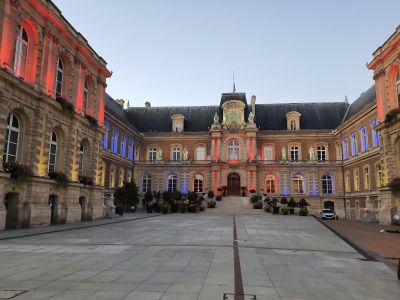
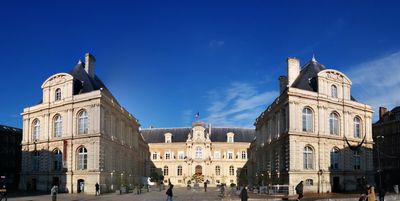
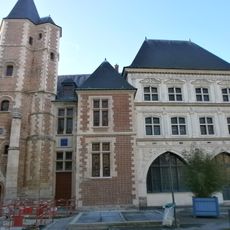
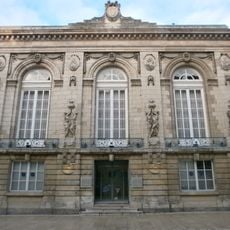
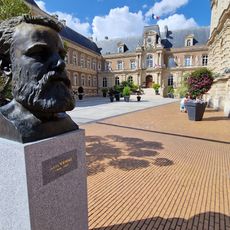
Amiens City Hall is a U-shaped brick and stone building on Place de l'Hôtel de Ville, with a central block and two wings around a paved courtyard. The central block has a slate mansard roof with dormer windows, a clock above a balcony, and a wooden door reached by steps. Three statues stand on the central facade, and the cream-colored stone wings have tall windows.
A first town hall was built on the site of the Gallo-Roman amphitheatre between 1551 and 1600; during the 1597 siege the Spanish general Hernán Tello de Portocarrero used it as headquarters, and Henry IV later received the citizens in its Great Hall. The present northern block, designed by Pierre-Louis Beffara and Jean-Jacques Jumel-Riquier, was completed in 1760, and the Treaty of Amiens was signed there in March 1802. The west wing followed in 1859 to a design by Louis Victor Amédée Vigreux and the east wing in 1880 by Louis Leullier; German shelling damaged the east wing in April 1918.
The Salle des Mariages keeps 17th-century oak panelling and a red marble fireplace, and the entrance hall floor carries a mosaic of the city arms. Twelve marble plaques set in 1893 list every mayor since the first known one. A painting by Jules-Claude Ziegler, hung in 1853, shows the Treaty of Amiens signed here in March 1802.
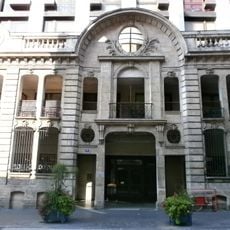
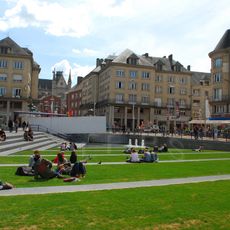
The building sits centrally at Place de l'Hôtel de Ville and is easy to reach on foot from most parts of the city center. Its prominent facade can be viewed clearly from various angles around the square.
The cast-iron gates that once closed the cour d'honneur were dismantled in 1992 and re-erected at the entrance of the Parc de la Hotoie. The courtyard they enclosed alternates brick and stone, and the main entrance was moved to this south side during the 19th-century extension.
The community of curious travelers
AroundUs brings together thousands of curated places, local tips, and hidden gems, enriched daily by 93,001 contributors worldwide.