Dolmen de Peygros, Dolmen in Mons, France
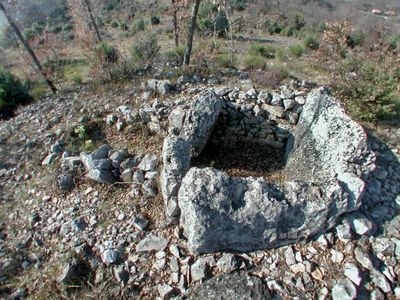
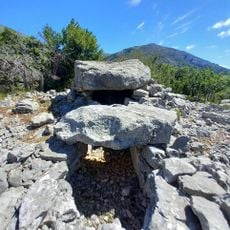
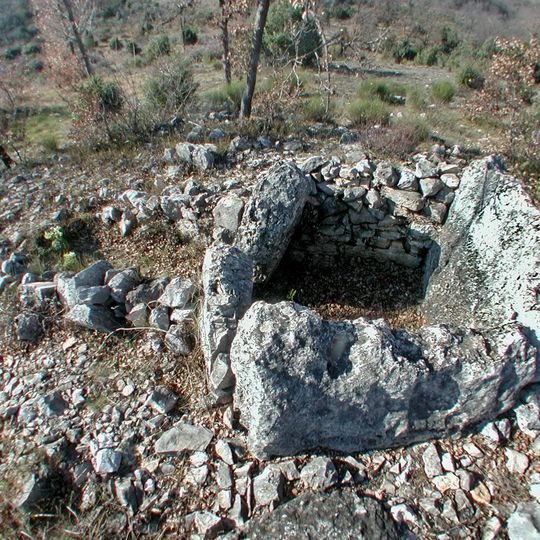
The Dolmen de Peygros is a small north-south oriented burial chamber set in a round cairn about 12 metres across, at 600 metres altitude below the Peygros summit near Mons. The chamber, roughly 1.8 metres long and 1.6 metres wide, is bounded by a 2.3-metre head slab bearing cupules, a 1.7-metre south slab resting on dry-stone footings, and a dry-stone wall on the north. Two orthostats about 2 metres high frame a 0.4-metre opening leading to a 1-metre-wide passage.
The dolmen was built thousands of years ago by early communities and was excavated twice, in 1908 and 1972. These excavations uncovered human bones and over 1700 teeth, along with artifacts from the Campaniforme culture including flint arrowheads, stone beads, bone pendants, and items made from gold and bronze.
The name Peygros comes from the summit above the site, where a cave of the same name opens. The finds from the chamber, including two flint points, V-perforated bone buttons, boar-tusk pendants, a gold spiral and bronze rings, belong to the Bell Beaker culture and are kept in the museum of Grasse.
The site sits about 600 meters above sea level and is easy to reach by car in the local area. Wear comfortable shoes, bring water, and plan your visit for cooler times of day since the exposed location offers little shelter from sun or wind.
The head slab closing the chamber's north end, 2.3 m long and 1.6 m high, carries small cup-shaped depressions (cupules) on its face. The 1908 dig by Count Edmond de Pas and the 1972 campaign by Gérard Sauzade yielded over 1,700 human teeth, now kept at the Musée de Grasse.
The community of curious travelers
AroundUs brings together thousands of curated places, local tips, and hidden gems, enriched daily by 94,546 contributors worldwide.