Former abbey church, Romanesque abbey church in Marmoutier, France.
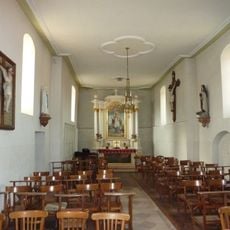
The former abbey church in Marmoutier is 74 metres long and grows younger from west to east: the Romanesque westwork of around 1140–1150 has three gables, two flanking towers with octagonal tops and a 36-metre main tower, while the Gothic nave of 1225–1235 has four rib-vaulted bays and the choir was rebuilt in 1761–1767.
The monastery existed by the 7th century; fires destroyed earlier churches in 827 and 950, and foundations of the Carolingian successor are visible in the crypt. The Romanesque westwork dates from around 1140–1150, and the nave was built in Gothic forms from about 1225 to 1235. Attacks during the Peasants' War of 1525 and the Thirty Years' War left the abbey church without major damage. The planned Baroque replacement of the westwork was abandoned when the French Revolution broke out and the monastery was dissolved.
The church is still known as abbatiale Saint-Étienne although it has served as the parish church of Saint-Martin since the abbey was dissolved after the French Revolution. It is a stage on the Romanesque Road of Alsace, and the 1710 Silbermann organ, moved to the west gallery in 1789, remains in use for services and concerts.
The church stands in the village centre; the west porch opens onto the square through three arches, so the Romanesque facade and its sculpture are seen before entering. The building is a listed Monument historique and an active parish church, so visits fit around services. The crypt, rebuilt after excavations, and the raised west gallery are reached from inside.
The organ by Andreas Silbermann, built in 1709–1710, was moved in 1789 from its rood-screen loft to the west gallery; the pedal division was raised three metres, so the large pedal pipes now show behind the main case. It is among the best-preserved Baroque organs.
The community of curious travelers
AroundUs brings together thousands of curated places, local tips, and hidden gems, enriched daily by 94,343 contributors worldwide.