Vieux-Poitiers, Archaeological site in Naintré and Cenon-sur-Vienne, France.
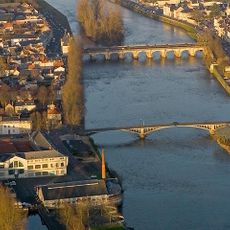
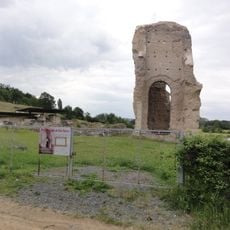
Vieux-Poitiers is a Gallo-Roman settlement site of about 65 hectares shared by Naintré and Cenon-sur-Vienne, near the Clain and Vienne confluence. Its most visible remnant is a 14-metre-high tower-like masonry structure, part of the cavea of a theatre 116 metres in diameter, with rows of small square holes in its face and a large arched opening at the base.
The settlement, originally named Briva, grew along a major Roman road and became a regional trading hub in the early centuries after Christ. As Roman administration withdrew, the town slowly lost its role and was eventually abandoned.
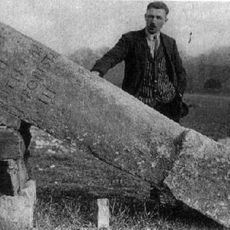
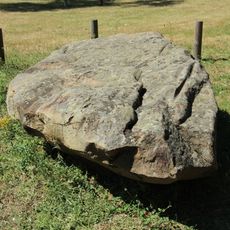
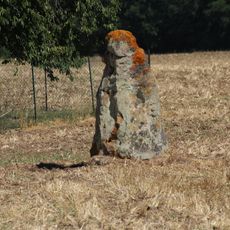
The name Briva comes from a Gaulish word meaning "bridge" or "ford", recorded in the Latin inscription on the Naintré menhir as Briuatiom, "inhabitants near the bridge". By the mid-8th century the site appears as Vetus Pictavis, the source of today's Vieux-Poitiers. The theatre stood at the south-eastern edge of the town, forming a single complex with a sanctuary.
The site lies in open countryside and can be visited on foot, though sturdy footwear is recommended as the ground is uneven in places. There is little shade, so visiting in the early morning or late afternoon is more comfortable during summer.
The most striking remnant is a 14-metre-high tower-like structure, part of the cavea of the theatre. The theatre was cut into a hillside over a height of about 12 metres and measured 116 metres across, with an orchestra of 900 m². Wooden scaffolding supplemented the stone, giving it a capacity of around 10,000 seats.
The community of curious travelers
AroundUs brings together thousands of curated places, local tips, and hidden gems, enriched daily by 94,540 contributors worldwide.