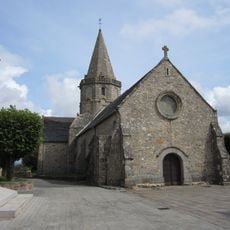
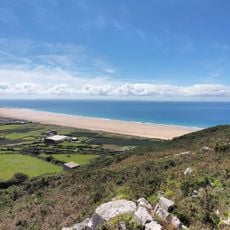
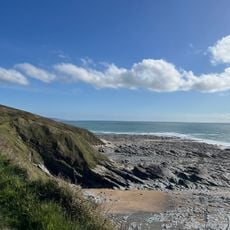
Site archéologique du Rozel, Archaeological site in Le Rozel, France.
The Rozel site is an archaeological location on the Normandy coast with remains from prehistoric settlements. Numerous stone tools, animal bones, and evidence of food preparation were discovered there.
The site was discovered in 1967 and revealed Middle Paleolithic finds including flint tools and animal remains from around 80,000 years ago. This discovery provided important insights into early human history.
Excavations uncovered three open-air butchery areas where aurochs, red deer, giant deer and horse bones bear cut marks from flint knives, some knapped on the spot. Meat was smoked over pine-wood and bone fires, laid on schist slabs prised from the cliff, and long bones were broken on schist and quartz blocks to extract marrow. A walrus jaw and feathers of white-tailed eagles, gulls and buzzards, possibly kept for ornament, were also found.
Archaeological teams work at the site during summer months when weather and conditions are favorable for excavation. Protective structures were installed in 2012 to safeguard the site from erosion caused by rising sea levels.
By June 2020, excavations had recorded 2,000 footprints on the site, including 257 foot and 8 hand impressions analysed between 2012 and 2017. One footprint belonged to a child about 2 years old, and the individuals identified ranged from 66 to 189 cm tall. The prints form a trampled patch crossed in every direction rather than a single trail.
The community of curious travelers
AroundUs brings together thousands of curated places, local tips, and hidden gems, enriched daily by 93,590 contributors worldwide.