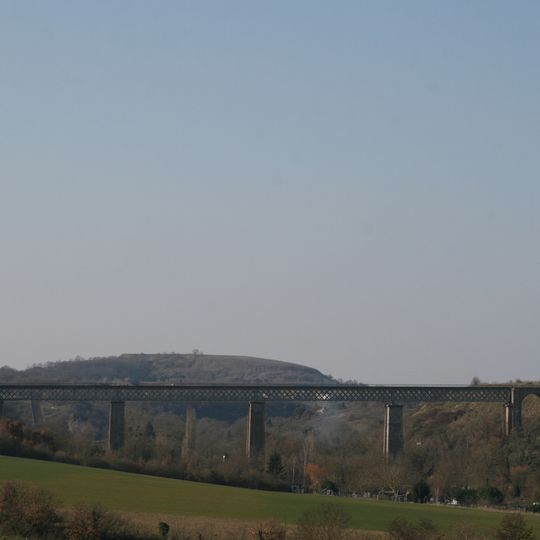
Thouars Viaduct, Railway viaduct in Thouars, France.
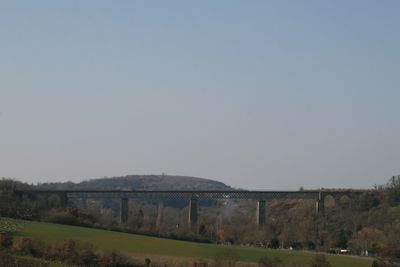
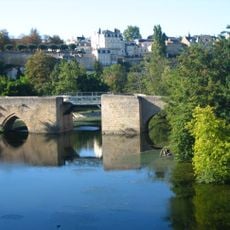
The Thouars Viaduct is a railway bridge over the Thouet between Thouars and Saint-Jacques-de-Thouars. Its metal deck, about 190 m long, rests on three lattice piers 28 m high, now clad in stone masonry, and continues at each end with masonry viaducts, giving a total length of 257 m. The four spans measure 43.50 m at the sides and 51.40 m in the centre, with a maximum height of 44 m.
The line from Tours to Les Sables-d'Olonne was planned from 1854 by the Compagnie des chemins de fer de la Vendée. The viaduct was built between 1871 and 1873 by G. Eiffel et Cie to plans by engineer G. Tyndall, at a cost of 623,280 francs. A second deck was added in 1887 for the Paris–Bordeaux line, and in 1914–1915 the metal piers were encased in concrete and stone facing.
The viaduct is also called the Eiffel Viaduct, after Gustave Eiffel's company G. Eiffel et Cie, which built it. On 3 June 2000 the town marked the year 2000 with a railway event: the steam locomotive Pacific 231 G 558, listed as a monument historique in 1984, crossed the viaduct to reach the station, with a sound and light show and about 7,000 people attending.
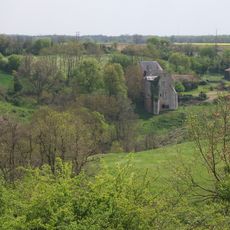
The viaduct crosses the Thouet between Thouars and Saint-Jacques-de-Thouars, on the Les Sables-d'Olonne to Tours line. It can be seen from the riverbanks and from the D938 road. The metal deck rests on stone-clad piers, and the masonry approach viaducts continue the crossing at both ends.
The deck was designed from the start to carry a second track: the piers were wide enough, and a second, lower girder deck was added in 1887 when the Paris–Bordeaux line through Thouars opened. The original piers were metal latticework, encased in stone masonry in 1914–1915 after the metal bridge at Montreuil-Bellay collapsed under a freight train in November 1913.
The community of curious travelers
AroundUs brings together thousands of curated places, local tips, and hidden gems, enriched daily by 94,550 contributors worldwide.